DCC control
Best DCC Boosters
Quick answer
The best DCC booster for most growing layouts is the Digitrax 8 Amp Auto-Reversing DCC Booster at $212.99, because 8 amps of auto-reversing output covers a large power district, including several sound locomotives running at once, without needing a second booster added soon after the first.
A booster exists to solve one problem: the command station's built-in amplifier only supplies so much current, and a layout with enough sound locomotives, lighted passenger cars or simply enough track eventually needs more than that. The Digitrax 8 Amp Auto-Reversing DCC Booster adds a second, independently powered district at up to 8 amps, with auto-reversing built in for a wye or a reversing loop, which is the single most common reason a booster gets added in the first place.
A booster is not a universal accessory. It connects to the command station's own bus, the same as a throttle, so a Digitrax booster works on a Digitrax system and does not connect to an NCE or ESU command station. If you have not chosen a DCC system yet, that decision, covered in our best DCC systems roundup, comes first.
On this page
- When does a layout actually need a booster?
- Booster comparison
- Best first booster for a layout outgrowing its command station
- Best flexible booster for an uncertain load
- Best booster for a large power district running several sound locomotives
- What is a power district, and why split a layout into more than one?
When does a layout actually need a booster?
Add a booster when the command station's rated amperage is close to, or already exceeded by, your actual running load, most commonly from several sound locomotives running together, since sound decoders draw noticeably more current than non-sound ones. A booster is also the standard way to wire a reversing loop or a wye without the short circuit a simple gap-and-jumper approach causes, since the Digitrax 8 Amp Auto-Reversing DCC Booster and the Digitrax DB210 Single 3/5/8 Amp Auto-Reversing DCC Booster both include auto-reversing detection built in.
Booster comparison
The Digitrax DB210 line covers most Digitrax layouts at three price and amperage points; the Bachmann E-Z Command booster serves a different ecosystem entirely.
The DB210 8A model doubles the amperage of the entry DB210 Advanced at roughly 45 percent more cost.
| Booster | Price | Ecosystem | Output | Auto-reversing |
|---|---|---|---|---|
| Digitrax 8 Amp Auto-Reversing DCC Booster | $212.99 | Digitrax LocoNet | 8A | Yes |
| Digitrax DB210 Single 3/5/8 Amp Auto-Reversing DCC Booster | $180.81 | Digitrax LocoNet | 3A/5A/8A selectable | Yes |
| Digitrax DB210 Booster Advanced with Single Auto Reversing 8A | $146.99 | Digitrax LocoNet | 8A (single reversing) | Yes |
| Bachmann E-Z Command DCC 5 Amp Power Booster for All Scales | $297.56 | Bachmann E-Z Command, all scales | 5A | No |
A booster only works on the command station bus it is built for. The Bachmann E-Z Command booster does not connect to a Digitrax, NCE or ESU system.
Best first booster for a layout outgrowing its command station
The Advanced model is the lowest cost way into a second Digitrax power district, and 8 amps on that single district is enough for most home layouts adding their first booster.
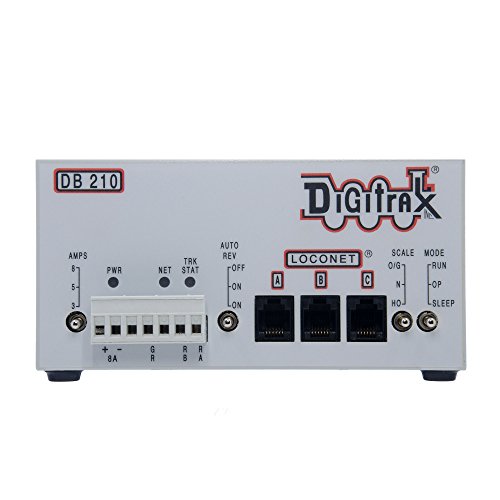
Digitrax DB210 Booster Advanced with Single Auto Reversing 8A
$146.99The lowest price entry into a second Digitrax power district, at a full 8 amp rating.
Best for: The first booster added to a growing Digitrax layout
Check price on AmazonBest flexible booster for an uncertain load
Selectable amperage lets you match the booster's output to the actual power district instead of guessing at purchase time.

Digitrax DB210 Single 3/5/8 Amp Auto-Reversing DCC Booster
$180.81Selectable 3, 5 or 8 amp output lets you match the booster to the actual power district after wiring it in.
Best for: A power district whose final locomotive count is not fully decided yet
Check price on AmazonBest booster for a large power district running several sound locomotives
A full 8 amp auto-reversing booster is the right call once a single power district is regularly running several sound-equipped locomotives at once.

Digitrax 8 Amp Auto-Reversing DCC Booster
$212.99A full 8 amps of auto-reversing output, sized for a large power district with several sound locomotives running together.
Best for: A large power district that has already outgrown a lower-amperage booster
Check price on AmazonWho should not buy this tier: Skip this for a small layout running one or two locomotives on the command station's own built-in amperage. A booster this size is meant for a power district that has already demonstrated it needs more current than the base command station supplies, not a precaution added before that need exists.
What is a power district, and why split a layout into more than one?
A power district is simply a section of track fed by its own booster or command station output, electrically separated from the rest of the layout by an insulated rail gap or joiner. Splitting a layout into multiple districts serves two purposes that often get confused with each other. The first is capacity: a district only needs to supply as much current as the locomotives running on it at one time, so a large layout split into several smaller districts, each fed by its own booster, can support far more total running current than a single command station output ever could alone. The second is fault isolation: a short circuit, a derailed locomotive bridging both rails, trips only the booster on that one district, leaving the rest of the layout running normally instead of shutting the whole railroad down.
A reversing section is a special case of the same idea, needing its own isolated district specifically because a wye or a loop forces a train to cross a point where the rails' electrical polarity has to flip. An auto-reversing booster like the Digitrax 8 Amp Auto-Reversing DCC Booster handles that flip automatically the instant it detects the short, rather than requiring a manual switch thrown at exactly the right moment as a train crosses the gap.
Wire gauge matters as much as booster amperage once a power district covers real distance. A booster capable of delivering 8 amps at its output terminals cannot deliver that same current reliably to the far end of a long run of undersized bus wire, since voltage drop over distance reduces what actually reaches the rail. Size the district's bus wire to the run length and the booster's rated output together, using the bus wire gauge calculator, rather than assuming a bigger booster alone solves a distant, dim-running locomotive. Feeder wires from the bus to the rail itself should be run at regular intervals along the whole district, not just at the booster connection point, for the same voltage drop reason, and this single wiring habit prevents more reliability complaints than any single piece of hardware covered in this roundup.
How we chose
We did not test these products in person and we never claim to. Picks are researched from manufacturer specification sheets and instruction manuals, published NMRA standards and recommended practices, and the recurring themes in verified owner reviews. Every pick is matched to a real scale, a real minimum radius or a real current draw rather than to a price bracket, and it is placed in the tier where its capability actually belongs. Where a product is wrong for most layouts we say so on the page, and where a figure is a hobby rule of thumb rather than a published standard we say that too.
Sources
- Digitrax and Bachmann published specifications
Frequently asked questions
Does a booster work with any DCC command station?
No. A booster connects to the command station's own bus, and Digitrax, NCE and ESU each use a different, incompatible bus. A Digitrax booster like the DB210 line only works on a Digitrax LocoNet system, so the booster choice is decided by whichever command station system you already own.
How do I know if my layout needs a booster?
Check your actual running current against the command station's rated amperage, using a tool like the DCC power budget calculator. Symptoms of an undersized command station include locomotives slowing or stalling when several sound-equipped trains run together, or the command station shutting down under a normal running load.
What does auto-reversing mean on a DCC booster?
An auto-reversing booster detects the short circuit that occurs when a train crosses into a reversing loop or a wye with mismatched rail polarity, and automatically flips the polarity to match, avoiding a manual switch or a hard stop. It is one of the standard ways to wire a reversing section on a DCC layout.
Can I add a booster from a different brand than my command station?
No, not directly. A booster is built for a specific command station's bus protocol, and mixing brands at this level generally does not work without a specialized interface device, which is uncommon and not something most home layouts use. Buy the booster from the same brand as the command station.
How many power districts does a typical home layout need?
Many home layouts run fine on a single power district from the command station alone. A second district, added with a booster, becomes worthwhile once the layout is large enough, or has enough sound locomotives running together, to regularly approach the command station's rated amperage, or once a reversing loop needs its own isolated section.
Does adding a booster require rewiring the whole layout?
No, only the section of track being moved onto the new power district needs to be electrically isolated from the rest of the layout with insulated rail joiners or a gap, then wired to the booster instead of the command station. The rest of the existing wiring is unaffected.
Researched, not professional advice. This page is compiled from published manufacturer specifications, instruction manuals, published NMRA standards and recommended practices, and owner-review consensus, not hands-on testing. Figures described as a rule of thumb are hobby convention rather than a standard, and they are labelled that way wherever they appear. Always check a radius, a clearance or a grade against your own equipment before you cut wood or lay rail, because manufacturers vary and so does what your specific models will tolerate. Any permanent mains wiring in a layout room is work for a licensed electrician to your local code.