Grade by rise and run
What grade is a 2 inch rise over 72 inches?
Quick answer
A 2 inch rise over 72 inches of run is a 2.78 percent grade. That is steep by model railroad standards. Workable, and you will feel it. Train lengths drop noticeably and helper locomotives stop being a novelty. The run is 6 feet, and the vertical transition at each end should be spread over at least a car length so couplers do not lift.
Grade is rise divided by run, expressed as a percentage, and nothing else comes into it. A 2 inch rise over 72 inches is 2 divided by 72, which is 2.78 percent.
Workable, and you will feel it. Train lengths drop noticeably and helper locomotives stop being a novelty.
The number that actually matters is not the grade on its own but what it does to the train you want to run. Every locomotive has a drawbar pull it cannot exceed, and a grade eats into it fast. The rule most operators arrive at is that a train which runs comfortably on the flat needs roughly a third fewer cars on a two percent grade, and a helper locomotive past that. Those are starting figures for planning and your own locomotives on your own track are the real test.
On this page
Is 2.78 percent a workable grade?
Workable, and you will feel it. Train lengths drop noticeably and helper locomotives stop being a novelty.
For context, a prototype mainline ruling grade is usually well under two percent, and the famously steep sections of American railroading sit between two and four percent with helper districts built around them. Model railroads routinely use steeper grades than the prototype because the run available is so much shorter, and the cost is paid in train length.
The second cost is less obvious: a grade that climbs also has to come back down, and a long train descending a steep grade pushes against the locomotive. In a model that shows up as stringlining, where the cars in the middle of the train pull sideways off the inside of a curve. A grade on a curve is the worst combination there is, and where a grade and a curve must coincide the sensible move is to reduce the grade through the curve.
How long a run does a 2 inch rise need?
If the rise is fixed, which it usually is because it is set by the clearance you need to cross over another track, then the grade is decided entirely by how much horizontal run you can give it. This is the table to plan from.
A 2 inch rise needs 100 inches, about 8.3 feet, of run to stay at a 2 percent grade.
| Target grade | Run needed | In feet | Verdict | What to expect |
|---|---|---|---|---|
| 1% | 200 in | 16.7 ft | Moderate | The usual model railroad compromise, and about where a prototype mainline ruling grade sits. Expect to shorten long trains or add a second locomotive. |
| 1.5% | 133 in | 11.1 ft | Moderate | The usual model railroad compromise, and about where a prototype mainline ruling grade sits. Expect to shorten long trains or add a second locomotive. |
| 2% | 100 in | 8.3 ft | Steep | Workable, and you will feel it. Train lengths drop noticeably and helper locomotives stop being a novelty. |
| 2.5% | 80 in | 6.7 ft | Steep | Workable, and you will feel it. Train lengths drop noticeably and helper locomotives stop being a novelty. |
| 3% | 67 in | 5.6 ft | Severe | Short trains only, and traction becomes the limiting factor rather than motor power. Fine for a logging or mining branch, painful on a mainline. |
| 4% | 50 in | 4.2 ft | Extreme | Past what most ready-to-run equipment will pull reliably. Treat this as a design error unless the whole layout is built around very short trains. |
The run is measured along the track, not across the room. A grade that climbs while it curves gets its run from the arc length of the curve, which is longer than the straight line distance and is the usual reason a helix works at all.
How much rise do you actually need?
Most grades exist to get one track over another. The rise needed is the clearance above the railhead plus the thickness of whatever the upper track sits on, and the second part is the one people forget.
In HO scale, crossing over another track needs about 3.37 inches of rise railhead to railhead, which at 2 percent takes 169 inches of run.
| Scale | Clearance above railhead | Subroadbed | Total rise | Run at 2 percent |
|---|---|---|---|---|
| N | 1.43 in | 0.75 in | 2.17 in | 109 in at 2% |
| HO | 2.62 in | 0.75 in | 3.37 in | 169 in at 2% |
| O | 4.75 in | 0.75 in | 5.5 in | 275 in at 2% |
Clearance above the railhead is scaled from a 19 foot prototype clearance, which covers ordinary equipment. Double stack container cars and high cube auto racks need more, so check your own tallest equipment rather than trusting a general figure. NMRA Standard S-7 covers clearances.
The vertical transition at each end
A grade that starts abruptly is a worse problem than a grade that is slightly too steep. At the bottom of the grade the track goes from level to climbing in one joint, which lifts the couplers of a long car and can drop the pilot of a long locomotive into the railhead. At the top the reverse happens and the car ends dig in.
The fix is to spread the change over a length rather than making it at a point. Common practice is a transition of at least one and a half times the length of the longest equipment, so for a 11.7 inch HO passenger car that is about 17.5 inches at each end. Over that distance the grade eases in gradually instead of arriving all at once.
In practice this is easy with plywood or foam subroadbed, which will not bend sharply anyway if you let it find its own curve. It is hard with rigid pre-cut risers, which is the main argument against them.
Roadbed and risers for building this grade
Chosen against the numbers on this page rather than from a general list, so the recommendation cannot contradict the arithmetic above.

Woodland Scenics N 2 foot Track-Bed Strips 36 Pack
$24.73The N scale profile, which is correctly narrower rather than just thinner. Thirty six strips is 72 feet, enough for a whole small layout.
Best for: an entire N scale layout in one purchase
Check price on Amazon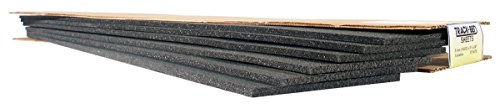
Woodland Scenics HO and O Track-Bed Sheets 6 Pack
$18.29Sheet rather than strip, for yards and industrial areas where the track is too close together for individual roadbed shoulders to make sense.
Best for: yards and engine terminals
Check price on Amazon
Woodland Scenics O Scale Track-Bed Roadbed Continuous Roll 24 foot
$20.99A continuous 24 foot roll, so there are no joints to line up on a long run of track. The O scale profile is much wider than HO.
Best for: long continuous runs in O scale
Check price on Amazon
Woodland Scenics Foam Nails 2 inch 75 Pack
$9.24Holds foam roadbed and track down while the adhesive sets, then pulls out. Track pins driven into foam do nothing on their own.
Best for: holding track down while glue cures
Check price on Amazon
Woodland Scenics 4 Percent Incline Set
$25.89Pre-cut foam risers at a fixed 4 percent, which removes the hard part of building a grade. Be aware 4 percent is a steep grade and will shorten your trains substantially.
Best for: a quick grade where train length is not the priority
Check price on Amazon
Manton Cork Sheets Model Railroad Cork HO and O 12 by 36 by 1/4 inch 4-Pack
$55.72Cork sheet for yards and large paved areas, where you want a flat base at roadbed height rather than a shouldered profile.
Best for: yards and flat areas at roadbed height
Check price on AmazonHow we chose
We did not test these products in person and we never claim to. Picks are researched from manufacturer specification sheets and instruction manuals, published NMRA standards and recommended practices, and the recurring themes in verified owner reviews. Every pick is matched to a real scale, a real minimum radius or a real current draw rather than to a price bracket, and it is placed in the tier where its capability actually belongs. Where a product is wrong for most layouts we say so on the page, and where a figure is a hobby rule of thumb rather than a published standard we say that too.
Sources
- NMRA Standard S-7, Clearances
- NMRA Standard S-1.2, General Standard Scales
Frequently asked questions
What grade is a 2 inch rise over 72 inches?
2.78 percent. Grade is rise divided by run expressed as a percentage, so 2 divided by 72 is 0.0278, which is 2.78 percent. By model railroad standards that counts as steep. Workable, and you will feel it. Train lengths drop noticeably and helper locomotives stop being a novelty.
What is the maximum grade for a model railroad?
There is no hard limit, only a trade against train length. Under 2 percent is comfortable and most trains run unchanged. Between 2 and 3 percent is workable with shorter trains or a helper locomotive. Past 4 percent traction rather than motor power becomes the limit, and only very short trains work. Logging and mining branches legitimately use steep grades because they run three cars.
How much clearance do I need to cross one track over another?
In HO scale about 3.37 inches railhead to railhead, which is roughly 2.62 inches of clearance above the lower railhead plus the subroadbed the upper track sits on. In N scale it is about 2.17 inches and in O about 5.5 inches. Double stack container cars need more than this, so measure your tallest equipment.
Does a curve make a grade harder?
Yes, noticeably. A curve adds rolling resistance on top of the grade, so a train that just manages a straight 2 percent grade can stall on the same grade through a curve. Where the two must coincide, reduce the grade through the curve. A grade on a curve is also where stringlining happens, which is the middle of the train pulling sideways off the inside rail.
How long should the transition at the top and bottom of a grade be?
At least about one and a half times the length of your longest piece of equipment, spread so the grade changes gradually rather than at a single joint. An abrupt start to a grade lifts couplers and can ground the pilot of a long locomotive, and it causes uncoupling that appears random until you notice it always happens in the same place.
Should I use pre-cut foam risers or build my own grade?
Pre-cut risers are quick and they come at a fixed percentage, commonly 2 or 4 percent, so the grade is decided for you. Building your own from plywood or foam lets you choose the grade and gives a natural vertical transition, because the material will not bend sharply on its own. If the fixed percentage suits your plan the risers save real time.
Researched, not professional advice. This page is compiled from published manufacturer specifications, instruction manuals, published NMRA standards and recommended practices, and owner-review consensus, not hands-on testing. Figures described as a rule of thumb are hobby convention rather than a standard, and they are labelled that way wherever they appear. Always check a radius, a clearance or a grade against your own equipment before you cut wood or lay rail, because manufacturers vary and so does what your specific models will tolerate. Any permanent mains wiring in a layout room is work for a licensed electrician to your local code.