Track plans in N
What can you build on a 1 by 12 foot shelf in N scale?
Quick answer
A 1 by 12 foot shelf is 12 by 144 inches, so the largest curve radius that fits is about 4 inches in N scale. That is too sharp for a continuous loop in N, so this space wants a switching layout instead. The area is 12 square feet.
A narrow switching shelf. No loop is possible at all, and a well designed switching layout on this gives more operating interest than most ovals.
The arithmetic is simple and it is the whole answer. A curve has to fit inside the width, so the largest possible radius is half the width minus a margin at each side. On 12 inches that gives 4 inches. Everything else follows from comparing that number against what your equipment needs.
A continuous loop does not work here in N. The largest radius that fits is 4 inches and even a 40 foot boxcar wants 9 inches. This space wants a switching layout, or a smaller scale.
On this page
What will run on a 4 inch radius in N?
Three representative pieces of equipment against the radius this space allows. The rule used is that minimum radius is about three times the car length, which is hobby convention rather than a published standard.
On a 1 by 12 foot shelf in N scale the maximum radius is 4 inches, which will not run a 50 foot boxcar.
| Equipment | Model length | Radius wanted | On this space |
|---|---|---|---|
| 85 foot passenger car | 6.38 in | 19.1 in | Does not fit |
| 50 foot boxcar | 3.75 in | 11.3 in | Does not fit |
| 40 foot boxcar | 3 in | 9 in | Does not fit |
A manufacturer stated minimum radius for a specific model always takes priority over this rule of thumb. Articulated steam locomotives take sharper curves than their length suggests because the front engine is hinged.
The same space in every scale
The most useful thing this page can tell you is which scale the space is really asking for. The same footprint is a cramped layout in one scale and a comfortable one in another.
A 1 by 12 foot shelf gives 4 inches of maximum radius in every scale, which is tight in N and too tight in O.
| Scale | Max radius | 50 ft car length | Radius wanted | Verdict |
|---|---|---|---|---|
| N | 4 in | 3.75 in | 11.3 in | Too small for a loop |
| HO | 4 in | 6.89 in | 20.7 in | Too small for a loop |
| O | 4 in | 12.5 in | 37.5 in | Too small for a loop |
The maximum radius is a property of the space, not the scale. What changes between scales is how much railroad that radius buys you.
What to build instead of a loop
This is the useful answer rather than the disappointing one: a switching layout in this space will give you more to do than a loop ever would, and it is what the space is genuinely suited to.
A switching layout has no continuous run. Instead it has a length of main line, a runaround track and several spurs serving industries, and the operation is the puzzle of getting the right cars to the right spurs in the right order with the runaround as your only means of getting the locomotive to the other end of the train. People build these deliberately in spaces far larger than this one.
The standard small switching plan needs a runaround long enough for your locomotive plus two or three cars, at least three spurs, and a track leading off the end of the layout representing the rest of the world. All of that fits in 12 square feet without anything being cramped.
The alternative is dropping a scale. In N scale the same 12 inch width gives a tighter but workable loop, which is the main reason people choose N in the first place.
How much track does this actually take?
A rough materials estimate for this footprint, assuming a loop at the maximum radius where one fits, plus a siding and a couple of spurs.
A loop at 4 inches radius is about 25.1 inches of track on its own, which is 1 lengths of three foot flex track before any sidings.
| Item | Figure |
|---|---|
| Table size | 12 by 144 in |
| Area | 12 sq ft |
| Maximum radius | 4 in |
| Track in one full loop | No loop fits |
| Three foot flex lengths for the loop | Not applicable |
| Suggested turnouts | 4 to 5, for a runaround and three spurs |
| Track centre spacing on straight | 0.98 in |
Track and plans for a 1 by 12 foot shelf in N
Chosen against the numbers on this page rather than from a general list, so the recommendation cannot contradict the arithmetic above.

Kato N Scale Unitrack 186 mm Straight Track 4 per Package
$9.80The standard N scale Unitrack straight, 7 5/16 inches long. The building block for lengthening a Unitrack layout.
Best for: extending an N scale Unitrack layout
Check price on Amazon
Kato N Scale 9 3/4 inch Double Track Straight Concrete Ties 2 Pack
$13.50Double track in one section with correct track centre spacing built in, which removes the commonest measuring error on a double track main line.
Best for: N scale double track with the spacing decided for you
Check price on Amazon
Woodland Scenics HO 2 foot Track-Bed Strips 12 Pack
$17.94Foam roadbed in pre-cut strips with the shoulder profile already there. Quieter than cork and it will not dry out and crumble the way cork can after some years.
Best for: HO roadbed that stays quiet
Check price on Amazon
Woodland Scenics N 2 foot Track-Bed Strips 36 Pack
$24.73The N scale profile, which is correctly narrower rather than just thinner. Thirty six strips is 72 feet, enough for a whole small layout.
Best for: an entire N scale layout in one purchase
Check price on Amazon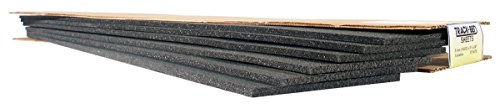
Woodland Scenics HO and O Track-Bed Sheets 6 Pack
$18.29Sheet rather than strip, for yards and industrial areas where the track is too close together for individual roadbed shoulders to make sense.
Best for: yards and engine terminals
Check price on Amazon
Kato N Scale CB&Q Pioneer Zephyr Unitrack Starter Set
$246.07 Specs and fitmentKato mechanisms and Unitrack are the reason N scale works reliably for beginners: the track locks together with a positive electrical joint rather than relying on rail joiners.
Best for: somebody who wants N scale to actually run well from the first evening
Check price on AmazonHow we chose
We did not test these products in person and we never claim to. Picks are researched from manufacturer specification sheets and instruction manuals, published NMRA standards and recommended practices, and the recurring themes in verified owner reviews. Every pick is matched to a real scale, a real minimum radius or a real current draw rather than to a price bracket, and it is placed in the tier where its capability actually belongs. Where a product is wrong for most layouts we say so on the page, and where a figure is a hobby rule of thumb rather than a published standard we say that too.
Sources
- NMRA Standard S-1.2, General Standard Scales
- NMRA Recommended Practice RP-11, Curvature and Rolling Stock
Frequently asked questions
What is the largest curve radius that fits on a 1 by 12 foot shelf?
About 4 inches. A curve has to fit within the width, so the maximum radius is half the 12 inch width less a margin at each side so the train is not running along the very edge. That figure is the same in every scale, because it is a property of the table rather than of the trains.
Can I build a continuous loop on a 1 by 12 foot shelf in N scale?
No, not sensibly in N. The 4 inch maximum radius is sharper than even a 40 foot boxcar wants. Either build a switching layout, which suits this footprint well, or use a smaller scale.
How many square feet is a 1 by 12 foot shelf?
12 square feet of layout surface. The room needs considerably more than that, because you have to reach the back of the table and walk around it. Allow roughly two feet of aisle on each side you need access from, which for a table layout usually means doubling the footprint.
Is N the right scale for this space?
Probably not, if you want continuous running. N equipment wants about 11.3 inches and this space gives 4. Going one scale smaller is the usual answer, and building a switching layout instead is the other.
What is the most common mistake on a layout this size?
Filling it with track. A small layout with too much track has nowhere for scenery, nothing that looks like a real place and very little to actually do, because every siding is too short to hold a useful train. One main line, one passing siding long enough for your longest train and two or three industries gives more operation and looks far better.
Should the layout have access from both sides?
If it is wider than about 30 inches, yes. Thirty inches is roughly how far most adults can reach comfortably, and track beyond that cannot be re-railed, cleaned or repaired without leaning on the scenery. A 12 inch table is within a comfortable reach from one side, which is one of its real advantages.
Researched, not professional advice. This page is compiled from published manufacturer specifications, instruction manuals, published NMRA standards and recommended practices, and owner-review consensus, not hands-on testing. Figures described as a rule of thumb are hobby convention rather than a standard, and they are labelled that way wherever they appear. Always check a radius, a clearance or a grade against your own equipment before you cut wood or lay rail, because manufacturers vary and so does what your specific models will tolerate. Any permanent mains wiring in a layout room is work for a licensed electrician to your local code.