Bus wire gauge
What wire gauge does a 50 foot DCC bus at 3 amps need?
Quick answer
A 50 foot DCC bus carrying 3 amps needs 12 AWG wire to keep the voltage drop at 0.476 volts, under the half volt limit. Remember the current travels out and back, so 50 feet of bus is 100 feet of copper. Plan on about 17 feeder drops, one every three feet.
The DCC bus is the pair of wires running under the layout that carries power and signal from the command station to the track. Getting it wrong produces symptoms that look like everything else: locomotives that slow at the far end, sound that cuts out, short circuits the booster does not detect, and decoders that reset for no apparent reason.
The calculation is ordinary electrical engineering. Voltage drop is current times resistance, and the resistance is the wire's resistance per foot times the length. The part people miss is that the current goes out on one conductor and comes back on the other, so a 50 foot bus is 100 feet of copper in the circuit. Forgetting that halves your answer and is the single most common wiring mistake on a large layout.
At 3 amps over 50 feet, 12 AWG keeps the drop to 0.476 volts, which is comfortably inside the half volt that keeps short circuit detection and decoder supply healthy.
On this page
Every gauge on a 50 foot bus at 3 amps
The round trip resistance and the resulting voltage drop for each common bus gauge. The limit used here is half a volt, which is the usual working figure: past that, the booster starts to have trouble telling a heavy load from a short circuit.
On a 50 foot bus carrying 3 amps, 12 AWG drops 0.476 volts, which is the lightest gauge that stays under the half volt limit.
| Gauge | Round trip resistance | Voltage drop | Verdict |
|---|---|---|---|
| 10 AWG | 0.1 ohms | 0.3 V | Within limit |
| 12 AWG | 0.159 ohms | 0.476 V | Within limit |
| 14 AWG | 0.253 ohms | 0.758 V | Too much drop |
| 16 AWG | 0.402 ohms | 1.205 V | Too much drop |
| 18 AWG | 0.639 ohms | 1.915 V | Too much drop |
Resistance figures are standard copper wire table values in ohms per 1,000 feet. The round trip distance used is 100 feet, which is twice the 50 foot bus length.
The same current over different bus lengths
If you are still planning and the bus length is not fixed, this is the table that shows what length costs you in copper.
At 3 amps, a 20 foot bus needs 16 AWG and a 50 foot bus needs 12 AWG.
| Bus length | Recommended gauge | Voltage drop |
|---|---|---|
| 10 ft | 18 AWG | 0.383 V |
| 15 ft | 16 AWG | 0.361 V |
| 20 ft | 16 AWG | 0.482 V |
| 25 ft | 14 AWG | 0.379 V |
| 30 ft | 14 AWG | 0.455 V |
| 40 ft | 12 AWG | 0.381 V |
| 50 ft | 12 AWG | 0.476 V |
| 60 ft | 10 AWG | 0.36 V |
The cheapest way to reduce required gauge is to shorten the bus by splitting the layout into power districts, each fed from its own booster or circuit protection, rather than running one long bus from a single point.
Feeder drops, and why rail joiners are not wiring
The bus does not power the track. Feeders do, and they are short wires soldered from the bus up to the rail.
The reason this matters is that a rail joiner is a mechanical connection, not an electrical one. It works when it is new and clean, and it degrades as the layout ages, as the joint oxidises and as the track expands and contracts with humidity. A layout relying on joiners for continuity develops dead sections over a year or two, and they move around, which makes them maddening to diagnose.
The standard practice is a feeder to every piece of rail. The common compromise is a feeder every three feet, which for a 50 foot run is about 17 drops. Feeders are short, so they can be much thinner than the bus: 22 AWG is normal, and because the run is only a few inches the voltage drop in a feeder is negligible.
Twisting the bus, and what it is actually for
The usual advice is to twist the two bus wires around each other a few turns per foot. It is worth doing and the reason is worth understanding, because it is not about voltage drop at all.
A DCC bus carries a square wave at a few kilohertz and a pair of parallel wires running for tens of feet is an antenna. Twisting them means each twist radiates in the opposite sense to the last, so the emissions largely cancel. It also reduces the loop area, which lowers the inductance of the run and keeps the DCC waveform's edges clean at the far end.
On a short bus none of this matters much. On a long one, a clean waveform is part of why decoders read reliably at the far end of the layout. A few turns per foot costs nothing and removes a variable.
The related question is whether the bus needs a termination network at the far end. On a long bus, a resistor and capacitor in series across the bus at the far end damps the reflection that rings off an unterminated cable end. It is worth adding on runs past roughly thirty feet and it is unnecessary on a small layout.
Wire and connections for a 50 foot bus
Chosen against the numbers on this page rather than from a general list, so the recommendation cannot contradict the arithmetic above.

BNTECHGO 22 Gauge Silicone Wire Spool 250 ft Brown Stranded Tinned Copper
$25.98A third colour, which is what you want for accessory and turnout wiring so it is never confused with the track bus.
Best for: accessory and turnout wiring
Check price on Amazon
Terminal Block 8 Circuits 600V 15A Dual Row Screw Terminal Strip 6 Sets
$13.89Screw terminals let a section of the layout be disconnected for fault finding without cutting anything. Tracing a short on a layout wired entirely with solder joints is genuinely miserable.
Best for: making layout wiring diagnosable
Check price on Amazon
Bachmann 10 foot Remote Switch Extension Wire
$17.46Extends the run between a turnout and its control box, which is needed as soon as the control panel is not right next to the track.
Best for: moving a turnout control away from the turnout
Check price on Amazon
Digitrax 8 Amp Auto-Reversing DCC Booster
$212.99Eight amps with auto-reversing built in, which is what a reversing loop needs to avoid a short every time a train crosses the gap. It is a booster only and needs a command station.
Best for: adding current and a reversing loop to a Digitrax layout
Check price on Amazon
Digitrax DB210 Single 3/5/8 Amp Auto-Reversing DCC Booster
$180.81Selectable 3, 5 or 8 amp output, so one booster suits N scale or large scale. Setting it higher than the layout needs is not a benefit: the current has to go somewhere in a fault.
Best for: a booster that matches the scale it is powering
Check price on Amazon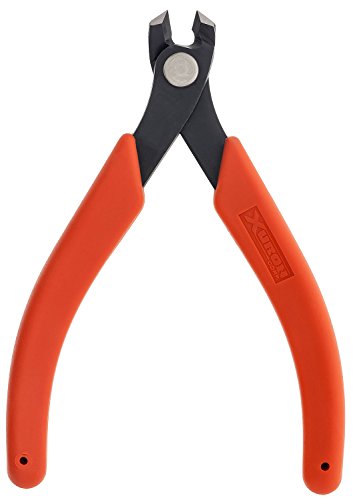
Xuron Vertical Track Cutter 2175M
$21.25Cuts rail cleanly with almost no distortion, which is what stops a kink at every joint. The vertical handle geometry lets you cut rail already laid on the layout.
Best for: cutting rail in place
Check price on AmazonHow we chose
We did not test these products in person and we never claim to. Picks are researched from manufacturer specification sheets and instruction manuals, published NMRA standards and recommended practices, and the recurring themes in verified owner reviews. Every pick is matched to a real scale, a real minimum radius or a real current draw rather than to a price bracket, and it is placed in the tier where its capability actually belongs. Where a product is wrong for most layouts we say so on the page, and where a figure is a hobby rule of thumb rather than a published standard we say that too.
Sources
- Standard copper wire resistance tables, ohms per 1,000 feet by AWG
- NMRA Standard S-9, Electrical
Frequently asked questions
What gauge wire for a 50 foot DCC bus at 3 amps?
12 AWG. That keeps the voltage drop to 0.476 volts over the 100 foot round trip, which is inside the half volt working limit. Going heavier costs little and does no harm, and going lighter causes symptoms that are hard to diagnose because they only appear at the far end of the layout under load.
Why is the round trip distance twice the bus length?
Because the circuit is a loop. Current flows out along one conductor and returns along the other, so both lengths are in the circuit and both contribute resistance. A 50 foot bus is 100 feet of copper. Calculating with the one way distance halves the apparent drop and is the most common wiring mistake on a large layout.
How far apart should DCC feeders be?
Every three feet is the common practical rule, which on a 50 foot run is about 17 drops. The counsel of perfection is a feeder to every individual piece of rail. Rail joiners are a mechanical connection rather than a reliable electrical one, and a layout that depends on them develops dead sections as it ages.
What gauge should the feeders themselves be?
22 AWG is normal and entirely adequate. Feeders are only a few inches long, so even though the wire is thin the resistance in that short length is negligible. Thin feeders are also easier to solder to the side of the rail without melting the ties and easier to hide once the track is ballasted.
Why should I twist the bus wires?
To cancel radiated emissions and keep the DCC waveform clean. Two parallel wires carrying a square wave for tens of feet behave as an antenna, and twisting them means successive twists radiate in opposite senses so the emissions largely cancel. It also lowers the loop inductance, which keeps the signal edges sharp at the far end. A few turns per foot is enough.
Is one long bus better than several power districts?
Several districts is better on any sizeable layout. Splitting the layout shortens each bus run, which reduces the gauge needed, and it means a short circuit in one area does not stop trains everywhere else. Each district gets its own circuit protection, and that containment is worth more than the wire saved.
Researched, not professional advice. This page is compiled from published manufacturer specifications, instruction manuals, published NMRA standards and recommended practices, and owner-review consensus, not hands-on testing. Figures described as a rule of thumb are hobby convention rather than a standard, and they are labelled that way wherever they appear. Always check a radius, a clearance or a grade against your own equipment before you cut wood or lay rail, because manufacturers vary and so does what your specific models will tolerate. Any permanent mains wiring in a layout room is work for a licensed electrician to your local code.