Paint & weathering
Best Airbrushes for Model Trains
Quick answer
The best airbrush kit for painting a locomotive body evenly is the Master Airbrush Cool Runner II Air Brush Kit with Dual Fan Air Compressor at $149.99, because its dual-fan compressor keeps running through a full paint session without the overheating shutdowns a cheaper single-fan compressor is prone to.
An airbrush is the only practical way to lay an even, brush-mark-free coat of paint across a locomotive shell, a freight car body, or a large scenery surface. It is also a tool a lot of modelers buy and barely use, because most of what people call "weathering" is better done with loose pigments and washes, not sprayed paint. The Master Airbrush Cool Runner II Air Brush Kit with Dual Fan Air Compressor is the pick if you are actually painting bodies; if you are only weathering rolling stock that is already painted, see best weathering powders and pigments instead and skip this purchase entirely.
For the paint itself, see best model train paint.
On this page
- What is an airbrush actually good for that a brush or a spray can is not?
- Who does not need an airbrush at all?
- Timbertech or Master Airbrush: which compressor kit is worth the extra cost?
- What does an airbrush actually cost beyond the kit itself?
- Beginner: a budget kit to learn control before committing further
- Intermediate: a compressor that keeps up once you are painting regularly
- Expert: this is also the practical ceiling for hobby-scale work
What is an airbrush actually good for that a brush or a spray can is not?
A brush leaves visible strokes and builds up paint unevenly at edges and panel lines, which is fine for a small detail but obvious across a whole locomotive shell. A rattle can sprays a fixed, usually wide pattern with no control over how thin or how targeted the coat is, and it is difficult to mask cleanly for a two-tone paint scheme. An airbrush lets you thin the paint, control the spray pattern and the air pressure, and build up thin, even coats, which is what a locomotive body, a passenger car roof, or a large scenery backdrop actually needs. See our comparison of airbrush versus spray can for more on when a rattle can is genuinely the better choice.
Who does not need an airbrush at all?
If your painting consists of touching up a handrail, a coupler, or a small detail part, a small brush and a bottle of Testors 9146XT Enamel Paint Set does that job better and with far less cleanup than setting up a compressor. And if what you actually want is weathering, soot streaks, rust, dust, and grime on rolling stock that is already painted the color it needs to be, loose pigments like Micro-Mark Doc OBriens Weathering Powders Set of 12 Colors do that more convincingly and more reversibly than an airbrush ever will. An airbrush earns its cost specifically when you are changing or applying a base color across a large, visible surface. Buying one before you have that project is the most common way an airbrush ends up unused in a drawer.
Timbertech or Master Airbrush: which compressor kit is worth the extra cost?
Both kits include a gun and a compressor; the difference is almost entirely in the compressor's ability to run without overheating.
The dual-fan Master Airbrush kit costs about twice as much but is built to run continuously through a longer session.
| Kit | Compressor | Best for | Price |
|---|---|---|---|
| Timbertech Airbrush Kit with Compressor Dual Action Gravity Feed | Single-fan, gravity feed | Occasional small parts and touch-ups | $75.99 |
| Master Airbrush Cool Runner II Air Brush Kit with Dual Fan Air Compressor | Dual-fan, cooler running | Full locomotive bodies, longer sessions | $149.99 |
What does an airbrush actually cost beyond the kit itself?
The gun and compressor are only part of the ongoing cost. Paint has to be thinned to a consistency the airbrush can atomize, which for most acrylics means a dedicated airbrush thinner or reduced acrylic, not paint straight from the bottle at brush consistency; using unthinned paint is the single most common reason a first-time airbrush user gets sputtering or clogging instead of a smooth spray. Cleanup between colors also takes real time: a properly cleaned airbrush needs thinner or cleaner flushed through the cup and the internal passages until it runs clear, which is a five to ten minute job done properly, and a much longer one if paint is allowed to dry inside the gun first.
A basic respirator or at minimum a well-ventilated space, and a simple spray booth or an open window with a fan pulling air away from you, round out the real cost of airbrushing beyond the initial kit price. None of this is expensive, but it is worth budgeting the time and the small recurring cost of thinner and cleaner alongside the compressor itself, since skipping any of it is what turns an airbrush into the "bought it, used it twice, gave up" story so many modelers tell.
Beginner: a budget kit to learn control before committing further
Learning to thin paint correctly and control spray distance matters more than the equipment at first, so a lower-cost kit is a reasonable place to start.
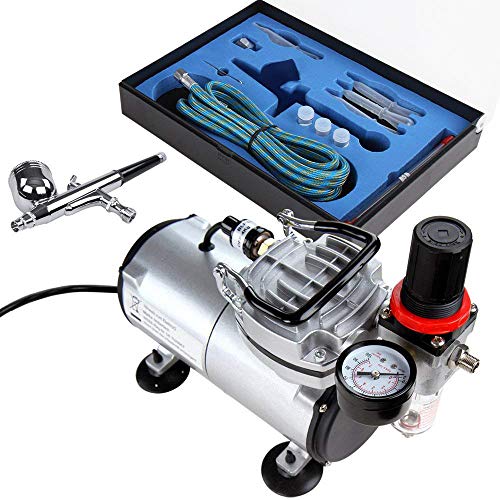
Timbertech Airbrush Kit with Compressor Dual Action Gravity Feed
$75.99A complete gun and compressor kit at a price low enough to learn on without a large commitment.
Best for: A first attempt at painting a structure or a single locomotive shell
Check price on AmazonIntermediate: a compressor that keeps up once you are painting regularly
Repainting several locomotives, or basecoating scenery pieces on a regular basis, starts to expose the limits of a single-fan compressor.

Master Airbrush Cool Runner II Air Brush Kit with Dual Fan Air Compressor
$149.99Runs cooler through a longer session, which matters once a project is more than one small part.
Best for: Repainting locomotives, basecoating scenery, regular use
Check price on AmazonExpert: this is also the practical ceiling for hobby-scale work
Tank compressors, multiple interchangeable guns, and studio-grade equipment matter to full-time professional airbrush artists working across many surfaces a week. On an N or HO scale locomotive body, that extra equipment does not meaningfully change the outcome.
Master Airbrush Cool Runner II Air Brush Kit with Dual Fan Air Compressor
$149.99The same dual-fan kit that serves an intermediate modeler is genuinely enough for a serious hobbyist; the catalog does not carry, and most modelers do not need, a step beyond it.
Best for: Serious hobby use, custom paint schemes, kitbash projects
Check price on AmazonWho should not buy this tier: Skip an airbrush at any tier if you only weather rolling stock that is already painted. Loose pigments and washes replicate soot, rust and grime more convincingly and far more cheaply than a sprayed coat, and they do not require a compressor, a spray booth, or cleanup between colors.
How we chose
We did not test these products in person and we never claim to. Picks are researched from manufacturer specification sheets and instruction manuals, published NMRA standards and recommended practices, and the recurring themes in verified owner reviews. Every pick is matched to a real scale, a real minimum radius or a real current draw rather than to a price bracket, and it is placed in the tier where its capability actually belongs. Where a product is wrong for most layouts we say so on the page, and where a figure is a hobby rule of thumb rather than a published standard we say that too.
Frequently asked questions
Do I need an airbrush to weather a freight car?
No. Weathering, adding soot, rust, dust or grime to a car that is already the right base color, is usually done more convincingly with loose pigments or washes than with an airbrush. An airbrush is for applying an even base coat of paint, a different job.
What size compressor do I need for model railroad painting?
A small hobby-grade compressor, single or dual-fan, is enough for anything from a locomotive body to a structure kit. Tank compressors and larger studio equipment are built for continuous professional use across many pieces, which most hobbyists never approach.
Why does the compressor matter more than the airbrush gun itself?
A single-fan compressor can overheat and shut off mid-session on a longer paint job, interrupting a coat before it is even. A dual-fan compressor runs cooler and keeps supplying steady air pressure through the whole session, which shows up as a more even finish.
Is enamel or acrylic paint better for airbrushing a locomotive?
Acrylic thins more predictably with water or an airbrush-specific thinner and cleans up easier between colors. Enamel dries harder and can look more durable on handled parts, but needs a solvent-based thinner and cleanup. Our model train paint page covers both in more depth.
How do I know if my project actually needs an airbrush?
If you are changing or applying a base color across a large visible surface, such as a whole locomotive shell or a structure facade, an airbrush is the right tool. If you are touching up a small detail or weathering an already-painted surface, a brush or loose pigments do that job better.
Can a cheap airbrush kit still produce good results?
Yes, for occasional use. A budget single-fan kit can paint a locomotive shell just as evenly as a more expensive one; the difference shows up in longer sessions, where a weaker compressor may overheat and cycle off before the coat is finished.
How long does it take to clean an airbrush properly between colors?
A thorough cleaning, flushing thinner or cleaner through the cup and internal passages until it runs clear, takes roughly five to ten minutes done right. Skipping it or rushing it is the most common cause of a clogged or sputtering airbrush on the next use, especially if paint is left to dry inside the gun.
Do I need a spray booth to use an airbrush indoors?
A dedicated spray booth is not required, but you need real ventilation, either a booth that pulls overspray outside, or an open window with a fan pulling air away from you. Airbrushing in a closed room with no airflow builds up fumes and fine overspray particles that are unpleasant and unhealthy to breathe.
Researched, not professional advice. This page is compiled from published manufacturer specifications, instruction manuals, published NMRA standards and recommended practices, and owner-review consensus, not hands-on testing. Figures described as a rule of thumb are hobby convention rather than a standard, and they are labelled that way wherever they appear. Always check a radius, a clearance or a grade against your own equipment before you cut wood or lay rail, because manufacturers vary and so does what your specific models will tolerate. Any permanent mains wiring in a layout room is work for a licensed electrician to your local code.