Scenery
Best Model Railroad Backdrops
Quick answer
The best model railroad backdrop for most HO layouts is Train Junkies Pine Forest HO Backdrop at $84.95. A generic forest scene suits nearly any era or region, unlike a themed backdrop such as a city skyline that locks the layout into one specific setting.
A backdrop is one of the few scenery choices that locks in a layout's setting the moment it goes on the wall, which is why a generic scene like Pine Forest or Georgia Forest is the safer first purchase over a specific theme like a city skyline or a steel mill. Forest and rural backdrops work behind almost any foreground scene, from a steam-era branch line to a modern short line, while a themed urban or industrial backdrop commits the layout to that specific setting for as long as the backdrop stays up.
The part most modelers get wrong is not the backdrop itself but the seam where the printed backdrop meets the painted sky above and the painted benchwork below. A visible seam or color mismatch breaks the illusion faster than a plain but well-blended backdrop with no seam at all. Run the sky and horizon colors through the backdrop paint calculator before painting, and see how to paint and hang a backdrop for the full process.
On this page
- Should I choose a generic scene or a themed backdrop first?
- How do I blend the seam between a printed backdrop and painted sky?
- Does layout lighting change how a backdrop and painted sky match?
- Best backdrop for an undecided layout theme
- Best backdrop for a themed industrial or urban layout
- Best backdrop technique for a fully blended scene
Should I choose a generic scene or a themed backdrop first?
A generic scene, forest or rural countryside, is the safer first purchase because it works behind nearly any layout theme and does not force a specific era or region. A themed backdrop like a steel mill or a city skyline looks fantastic when it matches the layout's actual setting, but it is a much bigger commitment, since it is difficult to run a rural branch line scene in front of an urban skyline without the mismatch standing out. Buy the themed backdrop once the layout's setting, era and region are firmly decided, and start with a generic scene if any of those are still undecided.
How do I blend the seam between a printed backdrop and painted sky?
Most printed backdrops cover the middle and lower portion of the wall, from a horizon line up through distant scenery, and leave the sky above to be painted separately so the backdrop can be trimmed to fit a specific benchwork height. The trick to a seamless transition is matching the exact sky color at the top edge of the printed backdrop, then painting upward from that matched color into a graduated sky tone, rather than painting a flat color that meets the printed sky at a hard, visible line. Run the color match through the backdrop paint calculator before opening a paint can, and feather the transition over several inches rather than a single hard edge. A foam roller blended with a dry brush at the seam itself, rather than a hard-edged paint line laid down with tape, also helps hide the transition when viewed from a normal seated or standing viewing height rather than up close.
Backdrops in this catalog split by scale and by theme, from generic forest scenes to specific urban and industrial settings.
Generic forest and mountain backdrops work across the widest range of layout themes, while urban and industrial scenes commit to one specific setting.
| Backdrop | Price | Scale | Theme |
|---|---|---|---|
| Train Junkies Pine Forest HO Scale Model Railroad Backdrop | $84.95 | HO | Generic forest |
| Train Junkies Georgia Forest Model Railroad Backdrop HO Scale | $84.95 | HO | Generic forest, southern region |
| Train Junkies Steel Mill Model Railroad Backdrop HO Scale | $84.95 | HO | Industrial, steel mill |
| Train Junkies New York City Model Railroad Backdrop HO Scale 18 by 120 inches | $84.95 | HO | Urban skyline |
| Train Junkies Appalachian Valley Model Railroad Backdrop N Scale 12 by 80 inches | $79.95 | N | Generic mountain valley |
| Train Junkies Fall Mountains Model Railroad Backdrop N Scale | $79.95 | N | Generic mountain, fall color |
Generic scenes suit an undecided or evolving layout theme. Themed scenes suit a layout with a firmly decided era, region and industry.
Does layout lighting change how a backdrop and painted sky match?
Yes, and this is a common reason a backdrop and painted sky that matched perfectly under one light source look mismatched under another. Warm incandescent-style lighting shifts colors toward yellow and orange, while cooler LED lighting shifts the same colors toward blue, so a sky color mixed and matched under one light source can look noticeably off once the final layout lighting is installed and turned on. The safest approach is to do the final color matching under the actual lighting the layout will be viewed under, not under a work lamp or daylight from a window, and to test a small painted sample against the backdrop's printed edge before committing to painting the full sky. A mismatch that is invisible under a workshop's overhead lights can become obvious the moment the layout's own lighting is switched on for the first time, which is a frustrating discovery after a full sky has already dried.
Best backdrop for an undecided layout theme
A generic forest scene keeps every future option open while the layout's era and region are still being decided.

Train Junkies Pine Forest HO Scale Model Railroad Backdrop
$84.95A generic pine forest scene that works behind almost any layout theme without committing to a specific era or region.
Best for: A layout whose era and region are not yet finalized
Check price on AmazonBest backdrop for a themed industrial or urban layout
Once the layout's setting is decided, a themed backdrop that matches it directly is a bigger visual payoff than a generic scene.
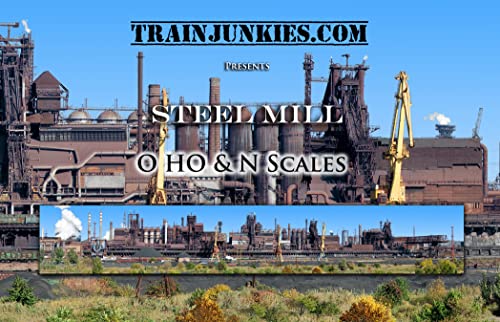
Train Junkies Steel Mill Model Railroad Backdrop HO Scale
$84.95A specific industrial backdrop for a layout built around heavy industry and rail-served manufacturing traffic.
Best for: A layout with a firmly decided industrial theme
Check price on AmazonBest backdrop technique for a fully blended scene
An experienced modeler treats the backdrop as one piece of a continuous scene rather than a flat picture hung behind the layout.

Train Junkies Georgia Forest Model Railroad Backdrop HO Scale
$84.95Used with a matched painted sky and foreground scenery blended into the printed horizon line for a seamless transition rather than a visible backdrop edge.
Best for: A layout where the backdrop, painted sky, and foreground scenery are planned together
Check price on AmazonWho should not buy this tier: Skip a fully blended backdrop treatment on a portable or temporary layout that gets set up and broken down repeatedly, since a hand-matched painted sky is more fragile and time-consuming to maintain than a simple hung backdrop panel, and repeated handling risks chipping a painted transition that a plain printed panel would survive without damage.
How we chose
We did not test these products in person and we never claim to. Picks are researched from manufacturer specification sheets and instruction manuals, published NMRA standards and recommended practices, and the recurring themes in verified owner reviews. Every pick is matched to a real scale, a real minimum radius or a real current draw rather than to a price bracket, and it is placed in the tier where its capability actually belongs. Where a product is wrong for most layouts we say so on the page, and where a figure is a hobby rule of thumb rather than a published standard we say that too.
Sources
- Train Junkies published backdrop specifications
Frequently asked questions
Should I buy a generic or themed model railroad backdrop first?
A generic scene, like a forest or rural countryside, is the safer first purchase since it works behind almost any layout theme. A themed backdrop, such as a city skyline or industrial scene, is a bigger visual payoff but only once the layout era, region and industry are firmly decided.
How do I blend a printed backdrop into a painted sky?
Match the exact color at the top edge of the printed backdrop, then paint upward from that matched color into a graduated sky tone rather than a flat color meeting the print at a hard line. Feathering the transition over several inches, rather than a single sharp edge, hides the seam.
What scale backdrops are available for N scale layouts?
N scale backdrops are typically taller relative to the layout footprint since N scale layouts often include more visible distant scenery in the same physical space. Generic mountain and valley scenes are common N scale backdrop themes, since N scale layouts frequently model broader, more open landscapes than a comparable HO layout.
Can I use a printed backdrop with hand-painted foreground scenery?
Yes, and this is the most common approach. The printed backdrop handles distant scenery that would be difficult to model in three dimensions, while foreground trees, buildings and terrain are built normally in front of it. Matching the color palette between the two keeps the transition from looking disjointed.
How do I hang a model railroad backdrop without visible seams?
Mount the backdrop flush against the benchwork or a dedicated backdrop board, trim the bottom edge to meet the layout surface precisely, and curve the backdrop gently into any corners rather than leaving a hard right angle, which draws the eye to the seam far more than a gentle curve does.
Does a backdrop need to match the exact era of the layout?
Ideally yes for a themed backdrop, since visible modern elements like contemporary vehicles or buildings in an otherwise steam-era backdrop will stand out. A generic natural scene, like a forest or mountain valley, avoids this problem entirely since it does not contain era-specific details that could conflict with the foreground scenery or the rolling stock running in front of it.
Researched, not professional advice. This page is compiled from published manufacturer specifications, instruction manuals, published NMRA standards and recommended practices, and owner-review consensus, not hands-on testing. Figures described as a rule of thumb are hobby convention rather than a standard, and they are labelled that way wherever they appear. Always check a radius, a clearance or a grade against your own equipment before you cut wood or lay rail, because manufacturers vary and so does what your specific models will tolerate. Any permanent mains wiring in a layout room is work for a licensed electrician to your local code.