Locomotives
Best N Scale Locomotives
Quick answer
The best N scale locomotive for most people is Kato N SD90/43MAC CP Pulling for United Way at $114.44, because Kato mechanisms are the benchmark in N scale for smooth slow-speed running, which is the single thing that most separates a good N scale locomotive from a frustrating one. Buyers who want DCC sound should expect to pay considerably more for it.
Smooth slow running matters more in N scale than in any other size, because switching moves and closely spaced yard work are harder to do convincingly when a locomotive lurches or stalls at low speed. Kato N SD90/43MAC CP Pulling for United Way is the pick for most people specifically for that reason: Kato's mechanisms have a long-standing reputation among N scale modelers for smoothness that other makers do not always match at a similar price.
DCC sound in N scale is honest to flag as a real compromise rather than a pure upgrade: the speaker has to fit inside a shell a fraction of the size of an HO locomotive's, and sound in N scale means a speaker small enough to be a little disappointing next to what the same decoder produces in HO.
On this page
- Why is slow-speed running such a big deal in N scale specifically?
- DC, DCC ready or DCC sound: how does the choice play out in N scale?
- Does wheel arrangement affect curve running in N scale the way it does in HO?
- Beginner: Kato reliability at the lowest entry price
- Intermediate: factory DCC sound on a common prototype
- Expert: a heavier six axle unit with sound
- Does N scale benefit from a smaller layout footprint per locomotive?
Why is slow-speed running such a big deal in N scale specifically?
An HO locomotive that lurches slightly at very low speed is a minor annoyance. The same lurch in N scale is proportionally larger relative to the smaller model and the tighter spacing typical of N scale trackwork, and it is far more visible when switching a yard or coupling to a car at a crawl. Kato N SD90/43MAC CP Pulling for United Way and other Kato mechanisms have built their reputation specifically on handling that low end of the speed range smoothly, which is a bigger practical difference in daily use than most other specs on the locomotive.
DC, DCC ready or DCC sound: how does the choice play out in N scale?
The same three-way decision that applies in HO applies here, with N scale’s size constraint added on top.
DCC sound locomotives in N scale cost meaningfully more than DC or DCC ready units of similar prototype, largely due to the miniaturized speaker and enclosure.
| Product | Wheel arrangement | DCC / sound | Best for |
|---|---|---|---|
| Kato N SD90/43MAC CP Pulling for United Way | C-C (six axle) | DC only | smoothest running at the lowest price |
| Bachmann GP38-2 DCC Ready Locomotive Chessie System N Scale | B-B (four axle) | DCC ready | adding a decoder of your own choice later |
| Bachmann GP40 DCC Sound Locomotive Burlington Northern N Scale | B-B (four axle) | DCC, sound | factory sound on a common modern prototype |
| Bachmann EMD SD40-2 Sound Locomotive CSX N Scale | C-C (six axle) | DCC, sound | a heavier six axle unit with factory sound |
Does wheel arrangement affect curve running in N scale the way it does in HO?
Yes, the same general pattern holds: a four axle B-B unit like Bachmann GP38-2 DCC Ready Locomotive Chessie System N Scale typically handles a tighter curve than a six axle C-C unit like Bachmann EMD SD40-2 Sound Locomotive CSX N Scale, and the six axle unit rides more heavily and wants more radius to look right doing it. N scale layouts are frequently built to tighter curves than HO ones simply because the whole layout is smaller, which makes this wheel arrangement difference worth checking against the actual minimum radius a plan uses before buying a heavier six axle locomotive for it.
Beginner: Kato reliability at the lowest entry price
A first N scale locomotive does not need DCC sound to be a good choice, and a smooth-running DC unit from a maker known for its mechanisms is arguably the better place to spend a limited budget than an entry-level DCC sound unit from elsewhere.
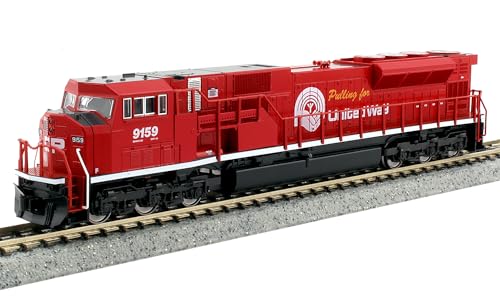
Kato N SD90/43MAC CP Pulling for United Way
$114.44 Specs and fitmentThe smoothest slow-speed running in this catalog at the lowest price of the four locomotives compared, with no DCC commitment required yet.
Best for: a first N scale locomotive on a layout not yet wired for DCC
Check price on AmazonIntermediate: factory DCC sound on a common prototype
Once a layout has DCC installed and sound has become worth the price premium, a four axle unit with sound already fitted at the factory is the buy-once pick that avoids a separate decoder purchase and installation.

Bachmann GP40 DCC Sound Locomotive Burlington Northern N Scale
$227.90 Specs and fitmentFactory DCC sound in N scale at a mainstream price, on a four axle prototype common enough to suit almost any modern era layout.
Best for: a DCC-equipped N scale layout that wants sound without shopping for a decoder separately
Check price on AmazonExpert: a heavier six axle unit with sound
A six axle road unit with factory sound is a heavier, better-riding locomotive than the four axle equivalents, and it wants a genuinely broader curve to look right doing it, which is why it belongs later in a roster once the layout’s geometry is already known to support it.

Bachmann EMD SD40-2 Sound Locomotive CSX N Scale
$279.71 Specs and fitmentA six axle road unit with factory sound, heavier and better riding than the four axle units, at the cost of wanting more radius to look right.
Best for: a settled N scale layout with curves broad enough for six axle power
Check price on AmazonWho should not buy this tier: a layout with tight curves still being finalized, or a first N scale purchase. Confirm the minimum radius the layout actually uses before buying a six axle unit at this price.
Does N scale benefit from a smaller layout footprint per locomotive?
Yes, in the sense that N scale packs more scale railroad into a given room than HO does, which is often the entire reason a modeler chooses it in the first place. That same compression means each individual locomotive purchase is doing more visual work per square foot of benchwork, so a smooth, reliable runner like a Kato mechanism matters more per locomotive than it might on a larger HO layout with more room to hide a rough runner in a long train.
How we chose
We did not test these products in person and we never claim to. Picks are researched from manufacturer specification sheets and instruction manuals, published NMRA standards and recommended practices, and the recurring themes in verified owner reviews. Every pick is matched to a real scale, a real minimum radius or a real current draw rather than to a price bracket, and it is placed in the tier where its capability actually belongs. Where a product is wrong for most layouts we say so on the page, and where a figure is a hobby rule of thumb rather than a published standard we say that too.
Frequently asked questions
Why are Kato locomotives considered the best runners in N scale?
Kato has a long-standing reputation among N scale modelers specifically for smooth slow-speed running, which is the trait that matters most for switching and closely spaced trackwork in the smallest common scale. That reputation is built on the mechanism itself rather than on DCC or sound features, many Kato N scale locomotives ship as plain DC units.
Is DCC sound in N scale worth the extra cost?
It depends on priorities. Factory DCC sound adds meaningfully to the price of an N scale locomotive, and the speaker inside such a small shell is inherently more limited than the same decoder produces in HO. Buyers who care most about sound realism sometimes prefer to put that budget toward HO instead, where speakers have more room to work.
Do six axle N scale locomotives need broader curves than four axle ones?
Generally yes, the same pattern that applies in HO holds in N scale: a six axle C-C unit typically wants a broader minimum radius than a four axle B-B unit of similar length, and it also rides more heavily and looks less correct on a very tight curve even when it can physically clear it.
What is Sound Value in N scale locomotives?
It is a reduced feature set sound decoder, offering factory-installed sound at a lower price than a full-featured decoder, in exchange for fewer selectable effects and a simpler setup. It is not a full sound decoder, and buyers wanting maximum sound features should expect to pay more for a locomotive without that reduced label.
Should I buy DC or DCC ready for my first N scale locomotive?
Match it to the layout’s wiring the same way you would in HO. A layout still running on plain DC gets no benefit from a DCC ready locomotive until a command station is added, so a plain DC unit is the more sensible first purchase if that describes your current setup.
Why does my N scale locomotive stall more than my HO ones?
N scale locomotives generally carry fewer pickup wheels than HO equipment because there is less physical room for them, so momentary loss of contact from dirt or a rough joint is more likely to visibly stall the train. Clean track and reliable joiners, such as Kato Unitrack’s locking design, matter more in N scale for exactly this reason.
Researched, not professional advice. This page is compiled from published manufacturer specifications, instruction manuals, published NMRA standards and recommended practices, and owner-review consensus, not hands-on testing. Figures described as a rule of thumb are hobby convention rather than a standard, and they are labelled that way wherever they appear. Always check a radius, a clearance or a grade against your own equipment before you cut wood or lay rail, because manufacturers vary and so does what your specific models will tolerate. Any permanent mains wiring in a layout room is work for a licensed electrician to your local code.