Scenery
Best Static Grass Applicators
Quick answer
The best static grass applicator for a full field or meadow scene is Woodland Scenics Static King at $82.01. It charges grass fibers so they stand upright instead of lying flat, which is the visual difference between a convincing meadow and loose fiber simply sprinkled onto glue.
An electrostatic applicator like the Static King works by putting a static charge through the grass fibers as they leave the tool, which makes them stand upright and root into the wet adhesive below rather than falling flat the way sprinkled ground cover does. That upright orientation is the entire visual difference between a convincing field of static grass and a patch of loose fiber glued down at random angles, and it is difficult to replicate by hand at any real scale.
For a small patch, though, a full applicator is not always necessary. Static-Tac spray adhesive, applied to a small area and followed by fibers pressed on and gently teased upright by hand or with a stiff brush, can produce a passable result for a handful of tufts along a fence line or around a building foundation. The applicator earns its price on anything larger than that, once hand-pressing an entire field becomes impractical.
On this page
- Do I need an electrostatic applicator or can I apply static grass by hand?
- What is the dedicated static grass applicator market like?
- How does an electrostatic applicator actually charge the grass fibers?
- Best static grass approach for a small patch
- Best static grass applicator for a first full field
- Best static grass technique for large or layered scenes
Do I need an electrostatic applicator or can I apply static grass by hand?
For a small area, a handful of tufts along a fence line, around a building foundation, or beside a rail, hand application with Static-Tac spray and a stiff brush to tease fibers upright can look reasonably convincing, since the eye is not comparing a small patch against a large uniform field. For anything larger, a full meadow, a hillside, or a wide field beside the track, an electrostatic applicator becomes worth its price, because charging the fibers to stand upright automatically is not something hand pressing can reliably reproduce at scale across a large area. See static grass vs ground foam for when loose ground foam is actually the better choice for a given scene.
What is the dedicated static grass applicator market like?
It is a small, specialized tool category, and Woodland Scenics is the name most modelers standardize on for a home layout, though other manufacturers including Noch and Peco also sell electrostatic grass applicators aimed at a similar market. If comparing options beyond the verified pick here, a Noch Grass-It applicator is a commonly cited alternative worth researching directly on current specifications and price before deciding. Whichever applicator is chosen, the tool works the same way in principle: a charged grid or wand stands loose grass fibers on end as they fall onto a wet adhesive base. Price and build quality vary more between brands than the basic principle does, so checking current reviews for a specific model before buying is worth the extra few minutes.
The core adhesive and the applicator are the two products in this category verified for this catalog, and how a modeler uses each depends on the size of the area being grassed.
The Static King is the applicator for full fields, while Static-Tac alone handles small hand-applied patches without a device.
| Product | Price | Role | Best for |
|---|---|---|---|
| Woodland Scenics Spray-Tac Adhesive | $11.98 | Adhesive base | Small patches, hand-applied |
| Woodland Scenics Static King | $82.01 | Electrostatic applicator | Full fields and meadows |
The applicator and the adhesive are typically used together on larger projects: Static-Tac wets the area, and the applicator charges and drops the fiber.
How does an electrostatic applicator actually charge the grass fibers?
An electrostatic static grass applicator works by running a low current through a screen or grid the fiber passes through on its way out of the tool, which gives each strand of fiber a static charge as it falls. Because the wet adhesive layer below is connected to the same circuit through a grounding clip, typically attached to a piece of foil or a metal pin pushed into the terrain, the charged fibers are drawn straight down and stand upright as they land, rather than falling flat under gravity alone the way sprinkled fiber does. This is the same basic principle behind static cling in a clothes dryer, applied deliberately and in one direction. A poor or missing ground connection is the most common reason a static grass session produces flat, poorly standing fiber even with a working applicator, so checking that the grounding clip has solid contact with the work area is worth doing before assuming the tool itself is faulty. Humidity also plays a role, since a very damp environment bleeds the static charge away faster than a dry one, which is why some modelers get noticeably better results running the applicator on a dry day or in a climate-controlled workshop rather than a damp basement.
Best static grass approach for a small patch
For a handful of tufts, the adhesive alone with a stiff brush does the job without buying a device at all.

Woodland Scenics Spray-Tac Adhesive
$11.98A tacky spray adhesive that, combined with hand-pressed fiber and a stiff brush, produces reasonable small patches without an applicator.
Best for: A few tufts along a fence line or foundation, no device needed
Check price on AmazonBest static grass applicator for a first full field
Once a project moves from a few tufts to an actual field or meadow, the electrostatic applicator becomes the buy-once tool worth owning.
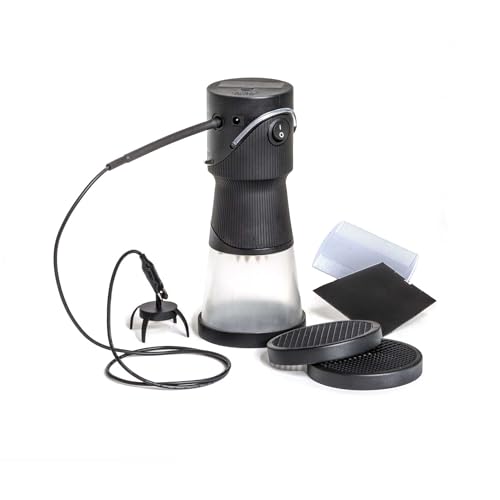
Woodland Scenics Static King
$82.01Charges grass fibers to stand upright automatically, the step that separates a convincing field from a hand-pressed patch.
Best for: A first full field or meadow scene
Check price on AmazonBest static grass technique for large or layered scenes
An experienced modeler gets more out of the same applicator by layering multiple fiber lengths and colors in passes rather than applying one uniform layer.
Woodland Scenics Static King
$82.01The same electrostatic applicator, used in multiple passes with different fiber lengths and colors layered for a wilder, less uniform meadow.
Best for: Large meadows built up in layered passes rather than one uniform application
Check price on AmazonWho should not buy this tier: Skip the layered, multi-pass technique for a single small scene. A basic single application, or hand-pressed fiber for a truly small patch, gets most of the visual benefit without the extra passes a large meadow calls for, and the additional fiber colors and lengths only earn their cost on a scene large enough for the variation to actually be noticed.
How we chose
We did not test these products in person and we never claim to. Picks are researched from manufacturer specification sheets and instruction manuals, published NMRA standards and recommended practices, and the recurring themes in verified owner reviews. Every pick is matched to a real scale, a real minimum radius or a real current draw rather than to a price bracket, and it is placed in the tier where its capability actually belongs. Where a product is wrong for most layouts we say so on the page, and where a figure is a hobby rule of thumb rather than a published standard we say that too.
Sources
- Woodland Scenics published product specifications
Frequently asked questions
What does a static grass applicator actually do?
It puts an electrostatic charge through loose grass fibers as they leave the tool, which makes the fibers stand upright and root into a wet adhesive layer below rather than lying flat the way sprinkled fiber does. That upright orientation is the visual difference a real static grass field is known for.
Do I need an applicator for a small area of static grass?
Not necessarily. A small patch, a handful of tufts along a fence line or foundation, can look reasonable with tacky spray adhesive and fiber pressed and teased upright by hand with a stiff brush. An applicator becomes worth its cost once the area is large enough that hand pressing is impractical.
Can I use static grass fiber without an electrostatic applicator?
Yes, by pressing the fiber into wet adhesive by hand and encouraging it upright with a stiff brush before the glue sets, though the result is less uniform than an electrostatically applied field, since hand pressing cannot charge and orient every fiber the way a proper applicator does.
How is static grass different from loose ground foam?
Ground foam is a loose, sprinkled material that sits flat and represents low undergrowth, moss or scattered ground texture. Static grass stands upright when properly applied and represents taller grass and meadow growth. Most realistic scenes use both together rather than relying on either material alone.
What fiber length should I use with a static grass applicator?
Shorter fiber lengths suit a mowed lawn or a well maintained field, while longer fibers suit an overgrown meadow or an untended lot. Many modelers layer two or more fiber lengths in the same scene, applying the longer fiber in patches over a base layer of shorter fiber for a more natural, uneven look.
Does static grass need to be sealed after application?
Once the adhesive beneath it has fully cured, a light overspray of a diluted scenic cement can help lock down any loose fiber at the edges of a scene, particularly in an area that gets handled or brushed against during operation. Fully cured static grass is generally durable without additional sealing otherwise.
Researched, not professional advice. This page is compiled from published manufacturer specifications, instruction manuals, published NMRA standards and recommended practices, and owner-review consensus, not hands-on testing. Figures described as a rule of thumb are hobby convention rather than a standard, and they are labelled that way wherever they appear. Always check a radius, a clearance or a grade against your own equipment before you cut wood or lay rail, because manufacturers vary and so does what your specific models will tolerate. Any permanent mains wiring in a layout room is work for a licensed electrician to your local code.