Track and operation
Turntable vs Wye for Turning Locomotives
Quick answer
A wye turns a locomotive with ordinary trackwork and no moving parts; a turntable is the most watched feature on a layout but needs a roundhouse or a fan of stall tracks to earn its footprint. The Atlas Code 83 Nickel Silver Wye Turnout HO Scale costs a fraction of the Walthers Cornerstone Motorized 110 foot Turntable with DCC HO Scale and does the same basic reversing job.
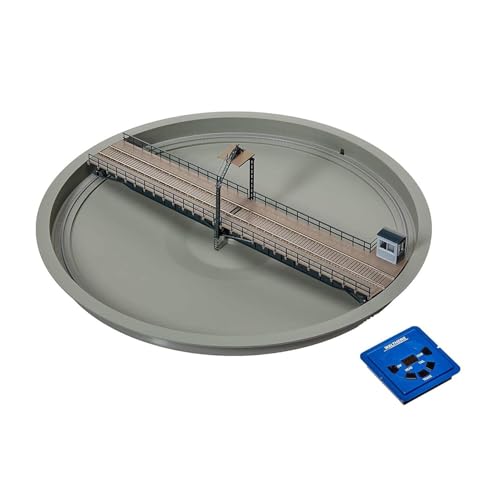
Walthers Cornerstone Motorized 110 foot Turntable with DCC HO Scale
$334.00Presents a locomotive precisely to a specific stall track in an engine terminal, and is the visual centerpiece of a roundhouse scene, at real cost and real depth.
Best for: a working HO engine terminal
Check price on Amazon
Atlas Code 83 Nickel Silver Wye Turnout HO Scale
$24.84Reverses a locomotive using ordinary track and turnout geometry, no moving parts beyond the turnouts themselves, at a fraction of the cost and depth.
Best for: a symmetrical junction in a tight space
Check price on AmazonIf the only goal is turning a locomotive around to face the other direction, a wye does that job for a fraction of the cost and a fraction of the benchwork depth a turntable needs, using track and turnout geometry a layout may already have room for. A turntable's real job is not simply turning a locomotive, it is presenting that locomotive precisely to a specific stall track in an engine terminal, indexing accurately enough that the locomotive does not step off a gap between the bridge rail and the stall track, which is a different and more specialized function than a wye performs.
The honest verdict is that a wye wins on cost and footprint for pure reversing, and a turntable wins as the visual and functional centerpiece of a roundhouse scene, storing and presenting several locomotives at once, something a wye cannot do at all.
On this page
What does a wye actually do, and what does it need?
A wye is three track legs meeting at a triangular junction, built from two turnouts such as the Atlas Code 83 Nickel Silver Wye Turnout HO Scale or a matched pair of ordinary turnouts, and a locomotive reverses direction by pulling into one leg, backing into the second, then pulling forward out the third, ending up facing the opposite way. It needs enough clear length in each leg to hold the locomotive or train being turned, and it needs no motor, no controller and no indexing mechanism, since it is just track. For a layout that already has room for a triangular junction somewhere in its plan, a wye adds a reversing capability essentially for the cost of turnouts already needed elsewhere.
Why is a turntable so much more than just a way to turn a locomotive around?
A turntable's precision requirement is what drives its cost. The Walthers Cornerstone Motorized 110 foot Turntable with DCC HO Scale has to rotate its bridge and stop it aligned closely enough with a chosen stall track that the locomotive's wheels roll smoothly across the gap without derailing, a function called indexing, and getting that indexing accurate and repeatable is most of what separates a $50 manual turntable from a $300 motorized, DCC-controlled one. A turntable also becomes the operational hub of an engine terminal, storing multiple locomotives around a fan of stall tracks and a roundhouse, and it is consistently one of the most watched, most photographed features on any layout that has one, which a plain wye simply is not built to be.
Does a reversing loop do the same job as either of these?
It accomplishes the same practical result, turning a train around, but through a different piece of track and a genuinely different wiring problem. A reversing loop is a loop of track that lets a whole train re-enter the mainline facing the opposite way without uncoupling or backing up, and on a DCC layout it needs a dedicated auto-reversing module to prevent a short circuit at the point where the loop's polarity meets the mainline's. A wye reverses a locomotive by backing and pulling through three separate legs rather than looping through a single curve, and it does not need the same auto-reversing electronics a loop does, though both approaches need careful electrical block planning either way.
Turntable vs wye, side by side
A wye reverses one locomotive using ordinary track at a fraction of a turntable's cost; a turntable indexes precisely to a roundhouse and serves as a layout centerpiece.
| Factor | Turntable | Wye |
|---|---|---|
| Cost | Roughly $50 to $340 depending on size and DCC control | Under $30 for the turnout itself |
| Footprint | A full circular pit, substantial depth | A triangular track arrangement, often fits an existing plan |
| Moving parts | Motorized bridge, needs indexing | None beyond the turnouts |
| Best use | Roundhouse and engine terminal scenes | Simple point-to-point or single-track reversing |
| Visual role | A layout centerpiece | Functional, not a scenic feature |
How do I decide which one my layout actually needs?
Ask what the layout's operating plan actually requires, not what looks impressive. A simple oval or point-to-point layout that just needs a locomotive to run in the other direction gets everything it needs from a wye, at a fraction of the space and cost. A layout built around a specific engine terminal scene, or one that wants to store and present multiple locomotives visually, is the scenario where a turntable's cost and footprint are actually earning their keep. See best model railroad turntables for the full lineup and how to wire a reversing loop for the wiring side of the alternative reversing loop approach.
Sources
- Walthers and Atlas published product specifications
Frequently asked questions
Is a wye cheaper than a turntable for turning a locomotive?
Substantially cheaper. A wye needs only the cost of the turnouts involved, often under thirty dollars for a compact wye turnout, while even a small manual turntable costs several times that, and a motorized, DCC-indexed model costs several hundred dollars. For pure reversing with no engine terminal scene planned, a wye is the lower cost option by a wide margin.
Does a wye need any wiring a turntable does not?
A wye needs the same basic block wiring considerations any turnout junction needs, and depending on the turnout type chosen, frog polarity may need attention. A motorized turntable adds its own wiring for the drive motor and, on a DCC model, for the indexing and stall track power routing, which a wye never has to address.
How much space does a wye actually need?
Enough clear track length in each of its three legs to hold the longest locomotive or train that will be turned there, since the equipment has to pull fully into one leg before backing into the next. A wye sized for a single short locomotive needs meaningfully less space than one sized for a full length train.
Can a turntable also serve as a reversing loop substitute?
Functionally yes, a turntable can turn a single locomotive the same way a wye or reversing loop can, but it is a far more expensive and space-hungry way to accomplish that one task alone. A turntable earns its cost specifically when an engine terminal scene with multiple stall tracks is also part of the plan.
Why does a turntable need such precise indexing?
Because the locomotive's wheels have to roll smoothly across the gap between the turntable bridge rail and whichever stall track it is aligned to, and even a small misalignment there can derail a locomotive or damage wheel flanges. Indexing accuracy is the main engineering challenge a turntable solves that a fixed piece of wye track never has to.
Is a manual turntable good enough, or do I need a motorized one?
A manual turntable works fine for occasional, hand-operated use and costs much less than a motorized model. A motorized, DCC-controlled turntable is worth the extra cost mainly for frequent operation, multiple operators, or a scene where hand-cranking the bridge into position repeatedly would become tedious during an operating session.
Researched, not professional advice. This page is compiled from published manufacturer specifications, instruction manuals, published NMRA standards and recommended practices, and owner-review consensus, not hands-on testing. Figures described as a rule of thumb are hobby convention rather than a standard, and they are labelled that way wherever they appear. Always check a radius, a clearance or a grade against your own equipment before you cut wood or lay rail, because manufacturers vary and so does what your specific models will tolerate. Any permanent mains wiring in a layout room is work for a licensed electrician to your local code.