Turnouts
Best Model Railroad Turnouts
Quick answer
The best all-around HO turnout is Atlas HO Code 83 Number 6 Left-Hand Super Switch at $27.40, because a number 6 is the general purpose geometry most published track plans assume for both main line and yard throat work. Sharper numbers save space but exclude longer equipment, and higher numbers cost more length than most yards can spare.
A turnout's number describes its geometry directly: it is the units forward for every one unit of sideways divergence, so a number 6 spreads one unit sideways for every six units forward. Higher numbers are gentler and longer, lower numbers are sharper and shorter. Atlas HO Code 83 Number 6 Left-Hand Super Switch is the size most HO track plans default to because it is the point where length, cost and how much equipment can take the diverging route without trouble all balance out.
A common and defensible combination on a real layout is a number 6 on the main line, where speed and appearance matter, and a number 4 in the yard, where space is short and speed does not matter.
On this page
- What does the number on a turnout actually mean?
- Electrofrog or Insulfrog: does the frog need power?
- Beginner: simple, manual, and cheap
- Intermediate: the number 6 most plans assume
- Expert: powered frogs, wired correctly
- Junctions, control hardware and long equipment
- HO turnouts by number and frog type
- Why does turnout choice matter more than it looks like it should?
What does the number on a turnout actually mean?
Turnout number is a ratio: units of length traveled forward for every one unit of sideways divergence between the two routes. A number 4 turnout diverges sharply in a short space, which is why it fits into tight yard throats where a number 6 or 8 simply will not. A number 8, like Atlas Code 100 Nickel Silver Mark 4 Number 8 Turnout Left Hand HO Scale, is long and shallow, and that gentle angle is what long passenger equipment needs to take the diverging route without lurching or the couplers binding.
None of this is arbitrary. NMRA RP-11 documents the standard turnout geometries, and a manufacturer's stated minimum wins over any rule of thumb when the two disagree.
Electrofrog or Insulfrog: does the frog need power?
The frog is the crossing point in the middle of a turnout where the diverging and straight rails physically cross, and whether it carries power is a real design choice with a real tradeoff. An Insulfrog, or dead frog, turnout leaves that crossing electrically neutral, which is simpler to wire and safer against wrong-way shorts, but it can stall a short wheelbase locomotive or a light car with few pickup wheels if it loses contact for even a moment while crossing the gap.
Peco HO Scale Code 83 Electrofrog Number 6 Right-Hand Turnout powers the frog instead, which eliminates that stalling problem outright. The cost is wiring complexity: an Electrofrog turnout must be wired correctly, with the frog polarity switched to match the route selected, or it will short the moment a wheel bridges the frog and the point rails at the same time. Done wrong, this is the single most common cause of a DCC system tripping its breaker at a turnout.
Beginner: simple, manual, and cheap
A manual snap switch needs no wiring beyond the two rail connections any turnout needs, and it is thrown by hand rather than by a powered switch machine. It is geometrically sharper than a number 6, so keep long equipment off the diverging route, but for a small first yard or siding it is the least expensive and least fussy way to add a turnout.

Atlas Code 83 Nickel Silver Manual Snap Switch Left HO Scale
$26.98No switch machine to wire or wiring polarity to get right, just a manual throw lever. Buy the matching {{p:atlas-snap-switch-right}} as a pair, since crossovers need one of each.
Best for: a first small yard or siding on a budget
Check price on AmazonIntermediate: the number 6 most plans assume
Once a layout is being built to a real track plan rather than improvised, a number 6 in code 83 is the safe default main line and yard-throat turnout that most published plans are drawn around.

Atlas HO Code 83 Number 6 Left-Hand Super Switch
$27.40General purpose geometry in the current-standard rail code, correct for most main line and yard throat locations on a published track plan.
Best for: following a track plan that specifies a number 6 turnout
Check price on Amazon
Atlas HO Code 83 Remote Right-Hand Turnout with Switch Machine
$34.23The same code 83 geometry with the switch machine already fitted, so it throws from a control panel rather than needing a hand thrown lever reachable from every angle.
Best for: a turnout that is not within easy hand reach from the front of the layout
Check price on AmazonExpert: powered frogs, wired correctly
An Electrofrog turnout removes the stalling problem that an Insulfrog turnout has with short wheelbase power, but only for a modeler prepared to wire the frog polarity correctly for both routes. Get it wrong and the result is a dead short rather than a stall.

Peco HO Scale Code 83 Electrofrog Number 6 Right-Hand Turnout
$44.59A powered frog eliminates the short-wheelbase stalling that an Insulfrog turnout is prone to, provided the frog polarity is switched correctly for the selected route.
Best for: a modeler comfortable wiring turnout polarity who is tired of stalls at a specific turnout
Check price on AmazonWho should not buy this tier: a beginner who has not wired a turnout before, or anyone who wants to avoid touching a soldering iron or a switch machine’s polarity contacts. An Insulfrog turnout is the safer starting point.
Junctions, control hardware and long equipment
A few other turnout products solve specific problems rather than being general picks: a wye turnout fits a junction into less length than a left or right turnout of the same effective radius, and control hardware turns a hand-thrown yard into a small panel.

Atlas Code 83 Nickel Silver Wye Turnout HO Scale
$24.84Splits the difference between two diverging routes equally, fitting a junction into much less benchwork than a standard left or right turnout would need.
Best for: a Y junction where there is no length to spare for a standard turnout
Check price on Amazon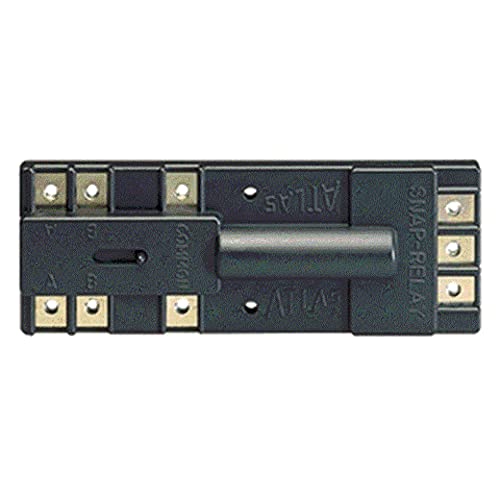
Atlas HO and N Snap Relay
$22.94Switches a second circuit, such as a panel indicator light or a powered frog’s polarity, at the same moment the turnout itself throws.
Best for: automating frog polarity or panel indicators on a remote turnout
Check price on Amazon
Atlas Switch Control Box HO Scale
$15.49The control box for a remote turnout, which gangs together with others into a simple control panel without any custom electronics work.
Best for: building a control panel for several remote turnouts at once
Check price on AmazonHO turnouts by number and frog type
The table below lines up the turnouts covered on this page by the two specs that actually decide where each one belongs on a track plan: the number, and whether the frog is powered.
A number 6 with a dead frog is the safest general-purpose default; a powered frog only pays off once the wiring is done correctly.
| Product | Number | Frog type | Best location |
|---|---|---|---|
| Atlas Code 83 Nickel Silver Manual Snap Switch Left HO Scale | Sharper than 6 | Insulfrog-style | small yard or siding, hand thrown |
| Atlas HO Code 83 Number 6 Left-Hand Super Switch | 6 | Insulfrog-style | main line and yard throat |
| Atlas Code 100 Nickel Silver Mark 4 Number 8 Turnout Left Hand HO Scale | 8 | Insulfrog-style | long passenger equipment |
| Peco HO Scale Code 83 Electrofrog Number 6 Right-Hand Turnout | 6 | Electrofrog (powered) | anywhere short wheelbase stalling is a problem |
Why does turnout choice matter more than it looks like it should?
A turnout is the single most complicated piece of track on a layout, since it has to guide wheels smoothly onto two different routes through one moving point rail assembly and, in a powered-frog design, switch electrical polarity at exactly the right moment. A cheap length of flex track that is slightly out of gauge is usually forgiving. A turnout built to the wrong number for its location, or wired incorrectly at the frog, causes a specific and repeatable derailment or short every single time a train crosses it. Getting the number and frog type right for each location on the plan is worth more than any other single decision in trackwork.
How we chose
We did not test these products in person and we never claim to. Picks are researched from manufacturer specification sheets and instruction manuals, published NMRA standards and recommended practices, and the recurring themes in verified owner reviews. Every pick is matched to a real scale, a real minimum radius or a real current draw rather than to a price bracket, and it is placed in the tier where its capability actually belongs. Where a product is wrong for most layouts we say so on the page, and where a figure is a hobby rule of thumb rather than a published standard we say that too.
Frequently asked questions
What does turnout number mean?
It is the ratio of units traveled forward to units diverged sideways, so a number 6 moves six units forward for every one unit sideways. Higher numbers are longer and gentler, lower numbers are shorter and sharper. NMRA RP-11 documents standard turnout geometries, and a manufacturer’s stated minimum radius for the diverging route always wins over a rule of thumb.
What turnout number should I use for a yard?
A number 4 is a common and defensible choice for yard ladders and throats, where space is tight and equipment moves slowly. A number 6 on the main line and a number 4 in the yard is a standard combination on real track plans, trading a little length savings in the yard for speed and appearance on the main.
Is Electrofrog better than Insulfrog?
Neither is universally better. Electrofrog eliminates stalling on short wheelbase equipment by powering the frog, but it must be wired correctly or it shorts. Insulfrog is simpler and safer to wire since the frog carries no current, at the cost of possible stalls on light or short locomotives crossing it.
Can I use a number 4 turnout on a main line?
You can, but a number 4 is noticeably sharper than a number 6 and will slow trains visibly and increase the chance of a coupler binding on longer equipment taking the diverging route. It is a better fit for yards and industrial spurs than for a scenic main line if space allows a gentler number instead.
Do manual turnouts need a switch machine?
No. A manual snap switch or manual turnout is thrown by hand with a small lever built into the point rails, and it needs nothing beyond the rail power connections any turnout requires. A switch machine is only needed for remote or panel-controlled operation.
Why did my DCC system trip the breaker at a turnout?
This is the classic symptom of an Electrofrog turnout with incorrect frog polarity wiring, where a wheel bridges the frog and an adjacent rail of the opposite polarity at the same time. Insulfrog turnouts cannot cause this specific fault since their frogs carry no current at all.
Researched, not professional advice. This page is compiled from published manufacturer specifications, instruction manuals, published NMRA standards and recommended practices, and owner-review consensus, not hands-on testing. Figures described as a rule of thumb are hobby convention rather than a standard, and they are labelled that way wherever they appear. Always check a radius, a clearance or a grade against your own equipment before you cut wood or lay rail, because manufacturers vary and so does what your specific models will tolerate. Any permanent mains wiring in a layout room is work for a licensed electrician to your local code.