DCC boosters
Bachmann E-Z Command DCC Power Booster Review
Quick answer
Buy the Bachmann E-Z Command DCC 5 Amp Power Booster for All Scales once your E-Z Command layout starts tripping its command station's internal breaker, not before, because at $297.56 this booster adds 5 amps to a second power district and still needs a working command station wired into it to generate the actual DCC signal.
The Bachmann E-Z Command DCC 5 Amp Power Booster for All Scales is an add-on for owners of a Bachmann E-Z Command starter set whose layout has outgrown the small amp capacity built into the command station itself. It does not replace anything and it does not run on its own. It takes the DCC signal your command station already produces, re-amplifies it, and hands that extra current to a second power district you wire up separately from the first.
That distinction is the whole review. A booster is a power multiplier, not a brain, and buying one to fix a problem that is actually a wiring problem or a command-station problem wastes the money.
On this page
What the E-Z Command booster is actually for
According to Bachmann's published specifications, the Bachmann E-Z Command DCC 5 Amp Power Booster for All Scales outputs up to 5 amps of DCC track power for all scales. Most Bachmann E-Z Command starter sets ship with a command station rated well under that, often around 1 amp, which is enough for one or two small locomotives but not enough once a layout grows to include several sound-equipped locomotives, powered turnouts and lit passenger cars on the same electrical block.
The booster solves exactly that problem and nothing else. It does not add new features to your throttle, it does not extend your programming track, and it will not fix a layout that runs poorly because of dirty rail joints or an undersized bus wire. Run the Bachmann E-Z Command DCC 5 Amp Power Booster for All Scales into its own separately gapped power district, feed that district with its own set of dropper feeders, and it does what it is built to do.
How it fits into an E-Z Command layout
A booster only helps once the wiring around it is correct. This is the part of the install most reviews skip.
The booster adds current capacity, but only after the layout is split into gapped, separately fed power districts.
| Requirement | Why it matters |
|---|---|
| A gap between power districts | Prevents the command station and booster from fighting over the same rail section |
| A common rail connection back to the command station | Keeps the DCC signal phase-matched between districts |
| Its own set of dropper feeders | A booster cannot push current through a joint-only rail connection any better than the original circuit could |
| A layout actually drawing more than 1 amp | Below that, the stock command station already covers the load |
The limitation this booster does not fix
The most common mistake buyers make with a booster of any brand is expecting it to behave like a second command station. It cannot. A booster is not a command station and cannot work alone: unplug the command station and the Bachmann E-Z Command DCC 5 Amp Power Booster for All Scales has no DCC signal to amplify. If the goal is to run two independent throttles at once, or to add features like consisting and routes, the E-Z Command system's own ceiling is the actual limitation, not the amperage. Use the DCC power budget calculator to check whether the real problem on your layout is amperage or something else, like a low-quality rail connection, before spending on a booster.
Alternatives worth comparing before you buy
The E-Z Command booster is the correct choice only if staying inside the Bachmann ecosystem is the priority. If a bigger jump to a more capable command and control system is on the table anyway, it is worth stepping back and comparing full systems rather than just adding a booster to the one already owned, since the Digitrax versus NCE comparison covers what changes with either upgrade path.
Step up: the Digitrax 8 Amp Auto-Reversing DCC Booster is an 8 amp auto-reversing booster built for Digitrax LocoNet systems and outperforms this unit on raw capacity, but it requires a Digitrax command station rather than E-Z Command.
Budget pick within the same ecosystem: the Digitrax DB210 Single 3/5/8 Amp Auto-Reversing DCC Booster covers 3, 5 or 8 amp output depending on the internal fuse selected, and is worth a look if a future move away from E-Z Command is already planned.
Instead of a booster: if the layout is small and the real issue is current draw from too many sound locomotives idling at once, adding the NCE Power Cab DCC Starter Set as a complete replacement system sometimes costs less than staying on E-Z Command and stacking add-ons, and it is worth reading a full NCE Power Cab review before deciding.
Boosters compared side by side
Published specifications for the boosters most commonly cross-shopped with this one.
| Model | Price | Output current | Scales supported |
|---|---|---|---|
 Bachmann E-Z Command DCC 5 Amp Power Booster for All Scales Bachmann E-Z Command DCC 5 Amp Power Booster for All Scales | $297.56 | 5 A | All scales |
 Digitrax 8 Amp Auto-Reversing DCC Booster Digitrax 8 Amp Auto-Reversing DCC Booster | $212.99 | 8 A | N, HO and large scale |
 Digitrax DB210 Single 3/5/8 Amp Auto-Reversing DCC Booster Digitrax DB210 Single 3/5/8 Amp Auto-Reversing DCC Booster | $180.81 | 8 A | N, HO and large scale |
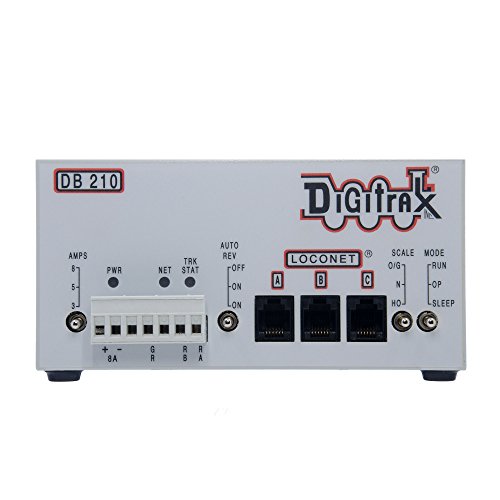 Digitrax DB210 Booster Advanced with Single Auto Reversing 8A Digitrax DB210 Booster Advanced with Single Auto Reversing 8A | $146.99 | 8 A | - |
How we chose
We did not test these products in person and we never claim to. Picks are researched from manufacturer specification sheets and instruction manuals, published NMRA standards and recommended practices, and the recurring themes in verified owner reviews. Every pick is matched to a real scale, a real minimum radius or a real current draw rather than to a price bracket, and it is placed in the tier where its capability actually belongs. Where a product is wrong for most layouts we say so on the page, and where a figure is a hobby rule of thumb rather than a published standard we say that too.
Sources
- Bachmann E-Z Command published product specifications
- NMRA DCC standards and recommended practices for command control wiring
- The consensus of verified owner reviews on booster installation and power districting
Frequently asked questions
Can the Bachmann E-Z Command booster run without a command station?
No. The manufacturer specifications describe it strictly as a signal amplifier, not a signal generator. It needs a working E-Z Command command station wired into it to produce the DCC waveform it then boosts and passes to a second power district. Without that connection it outputs nothing at all.
How do I know if I actually need a DCC booster?
The consensus of verified owner reports is that boosters solve current shortage, which shows up as locomotives stalling or a command station tripping its breaker under load. Run the numbers through the dedicated DCC power budget calculator first, since dirty track or thin bus wire causes the same symptoms without needing more amps.
Does adding a booster mean rewiring the whole layout?
It means wiring one new gapped power district, not touching what already works. The existing command station and its district stay as they are. The booster only powers the new section, connected back with a common rail wire so the DCC signal stays synchronized between the two districts.
Will the E-Z Command booster work with a different brand DCC system?
It is built and marketed for Bachmann E-Z Command systems specifically. Mixing DCC command stations and boosters across brands is not something manufacturers document as supported, so the consensus of verified owner reports is to stay within one ecosystem or plan a full system swap instead of a cross-brand mix.
What wire gauge does a booster power district need?
That depends on the length of the district and the current the booster can supply, not on the booster brand. The bus wire gauge calculator gives a specific answer once the run length and amperage are entered, rather than a single generic rule of thumb.
Is a booster cheaper than upgrading to a bigger DCC system?
Sometimes not. At $297.56, the E-Z Command booster costs a meaningful fraction of a full replacement system like the NCE Power Cab DCC Starter Set. Anyone already frustrated by E-Z Command's feature ceiling should price out both paths before assuming the booster is the cheaper fix.
Researched, not professional advice. This page is compiled from published manufacturer specifications, instruction manuals, published NMRA standards and recommended practices, and owner-review consensus, not hands-on testing. Figures described as a rule of thumb are hobby convention rather than a standard, and they are labelled that way wherever they appear. Always check a radius, a clearance or a grade against your own equipment before you cut wood or lay rail, because manufacturers vary and so does what your specific models will tolerate. Any permanent mains wiring in a layout room is work for a licensed electrician to your local code.