Scenery
Best Model Railroad Ballast
Quick answer
The best model railroad ballast for most HO layouts is Woodland Scenics Medium Ballast at $19.90. Grade must match scale: fine suits N, medium suits HO, coarse suits O, and using coarse ballast on HO track reads instantly as oversized boulders next to the rail.
Woodland Scenics Medium Ballast is sized for HO track, which is the scale most home layouts are built in, and using the correct grade matters more than which specific bag a modeler buys. Ballast grade is not a style choice the way color is. Real railroad ballast stone is roughly the same physical size regardless of the track gauge it supports, so a scale model has to shrink the stone along with everything else, and each grade corresponds to a specific scale: fine for N, medium for HO, coarse for O. Fitting the wrong grade to a scale is instantly obvious to anyone who has seen it done correctly, since coarse stone next to HO rail looks like a field of boulders rather than crushed rock.
Color is a real choice, unlike grade. brown and buff ballast suit branch lines and older, less maintained track, while a gray blend suits a well-kept modern mainline. Run the quantity your layout actually needs through the ballast and scenery calculator before buying, since ballast is sold by volume and running out mid-project means a second order in a dye lot that may not match exactly.
On this page
Grade is tied to scale, not to personal preference. Getting it wrong is a visible, avoidable mistake that shows up in every photo of the track.
Fine ballast suits N scale, medium suits HO, and coarse suits O, and mismatching grade to scale is the single most common ballast error.
| Grade | Correct scale | Products | What the wrong grade looks like |
|---|---|---|---|
| Fine | N | Woodland Scenics Fine Ballast Shaker Gray 50 cubic inches, Woodland Scenics Fine Ballast Shaker Gray Blend 57.7 cubic inches | Too fine for HO or O, disappears visually |
| Medium | HO | Woodland Scenics Medium Ballast Shaker Gray 50 cubic inches | Correct for HO, slightly large for N |
| Coarse | O | Woodland Scenics B89 Coarse Ballast Bag Gray 18 cubic inches | Reads as boulders if used on HO track |
See our full breakdown at fine vs medium ballast.
Why does ballast grade matter more than ballast color?
Color is a real modeling decision that reflects region, era and how well maintained a section of track is meant to look, and the site's medium gray pick works for most HO applications while brown suits a rougher branch line. Grade, though, is a physical fact tied to scale, not a style preference, because ballast represents a specific real-world stone size that has to shrink along with the rest of the model. A modeler who ballasts an N scale layout with medium HO-grade ballast, thinking bigger stone photographs better, ends up with track that looks like it is buried under gravel rather than fine crushed rock. Buy the grade that matches the scale first, then choose color for the era and region.
How much ballast does a layout actually need?
Ballast is sold by volume, typically listed in cubic inches per bag, and running short partway through a project is a real risk since a second bag from a different production run can be a slightly different shade even within the same named color. Measure the total length of track being ballasted, including sidings and yard tracks, and run it through the ballast and scenery calculator to estimate volume before buying. Buying one extra bag of the same lot up front is cheaper in practice than a second order later that does not quite match, especially on a mainline where the ballast is highly visible.
How do I ballast around a turnout without jamming the points?
A turnout is the one place on a layout where loose ballast is a real mechanical risk, not just a visual one, since a single stray grain lodged under a moving point rail can hold the points open just enough to cause a derailment that looks like a wiring or alignment fault. The safest approach is to ballast around a turnout with the points taped in one position, keep ballast well clear of the moving point rails and the throwbar underneath, and test the turnout by hand through its full range of motion before the glue sets, not after. Any stray grains found near the points are easier to pick out with tweezers before the glue dries than after, when they are cemented permanently in place.
Best ballast for a first HO layout
Medium gray is the correct grade for HO and suits nearly any mainline theme, making it the safest first bag to buy.
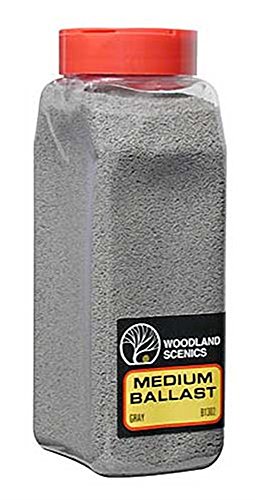
Woodland Scenics Medium Ballast Shaker Gray 50 cubic inches
$19.90The correct grade for HO track and a neutral gray color that suits most mainline themes without committing to a specific era.
Best for: A first HO layout with no settled era yet
Check price on AmazonBest ballast for a two-tone mainline and siding look
Real railroads often ballast a well maintained mainline differently from a lightly used siding, and mixing two colors is a simple way to add that realism.

Woodland Scenics Fine Ballast Shaker Buff 57.7 cubic inches
$20.79A lighter buff tone that reads as a less recently maintained siding or branch when paired with a darker mainline ballast.
Best for: Two-tone ballasting between a mainline and a siding
Check price on AmazonBest ballast for a multi-scale or O gauge layout
Coarse ballast is correctly sized for O gauge, and using it anywhere else on a mixed-scale layout or module set is a mistake worth avoiding.

Woodland Scenics B89 Coarse Ballast Bag Gray 18 cubic inches
$11.78Correctly sized coarse stone for O gauge track, matching the larger scale rather than reusing HO-grade ballast out of convenience.
Best for: O gauge layouts and modelers working across multiple scales
Check price on AmazonWho should not buy this tier: Do not use this on HO or N track. Coarse ballast on HO rail reads as an oversized field of boulders rather than crushed stone, and the mismatch is obvious in every photo of the track. It is also the wrong choice for a modeler who has not settled on O gauge as the primary scale for the layout.
How we chose
We did not test these products in person and we never claim to. Picks are researched from manufacturer specification sheets and instruction manuals, published NMRA standards and recommended practices, and the recurring themes in verified owner reviews. Every pick is matched to a real scale, a real minimum radius or a real current draw rather than to a price bracket, and it is placed in the tier where its capability actually belongs. Where a product is wrong for most layouts we say so on the page, and where a figure is a hobby rule of thumb rather than a published standard we say that too.
Sources
- Woodland Scenics published ballast grade specifications
- NMRA scale and gauge standards
Frequently asked questions
What ballast grade is correct for HO scale?
Medium grade ballast is correctly sized for HO scale track. Fine grade suits N scale, and coarse grade suits O gauge, since real ballast stone is roughly the same physical size across track gauges and each scale has to shrink that stone proportionally to look correct next to the rail.
What happens if I use the wrong ballast grade for my scale?
The mismatch is visually obvious. Coarse ballast on HO track looks like oversized boulders next to the rail rather than crushed stone, and fine ballast on O gauge track can look artificially smooth or disappear into the roadbed. Grade should always match scale, with color chosen separately for era and region.
Should ballast color match between the mainline and sidings?
Not necessarily, and using two shades on purpose adds realism. Many real railroads ballast a well maintained mainline with cleaner, darker stone and let sidings and branch lines weather to a lighter or browner tone over time, which a modeler can copy with two ballast colors of the same correct grade.
How is ballast applied to model railroad track?
Dry ballast is spread and shaped along the track with a small brush, then set permanently with a diluted glue solution applied by dropper so it soaks in without disturbing the shape. Pouring liquid glue directly onto loose ballast tends to wash it out of place rather than holding it.
How much ballast do I need for my layout?
Ballast is sold by volume, and the amount needed depends on total track length and how wide the ballast profile is built. Measuring total track footage and running it through a ballast calculator before buying avoids running short mid-project, since a second bag purchased later may not match the exact shade of the first.
Can I mix ballast brands as long as the grade matches?
Yes, as long as the grade is correct for the scale, mixing brands of the same grade is generally fine, though color can vary slightly between manufacturers even with similar names like gray or gray blend. Testing a small patch first is a reasonable precaution before ballasting a full mainline with a new brand.
Researched, not professional advice. This page is compiled from published manufacturer specifications, instruction manuals, published NMRA standards and recommended practices, and owner-review consensus, not hands-on testing. Figures described as a rule of thumb are hobby convention rather than a standard, and they are labelled that way wherever they appear. Always check a radius, a clearance or a grade against your own equipment before you cut wood or lay rail, because manufacturers vary and so does what your specific models will tolerate. Any permanent mains wiring in a layout room is work for a licensed electrician to your local code.