Scenery
Fine vs Medium Ballast
Quick answer
Fine ballast is correct for N scale and medium ballast is correct for HO, and using the wrong one is instantly obvious: medium grade under N scale track reads as riprap, while fine grade under HO track looks unnaturally smooth. The Woodland Scenics Fine Ballast Shaker Gray 50 cubic inches suits N; the Woodland Scenics Medium Ballast Shaker Gray 50 cubic inches suits HO mainline.

Woodland Scenics Fine Ballast Shaker Gray 50 cubic inches
$19.37Sized for N scale mainline, and an acceptable finer look in HO where a subtler texture is wanted.
Best for: N scale, and HO where a finer look is wanted
Check price on Amazon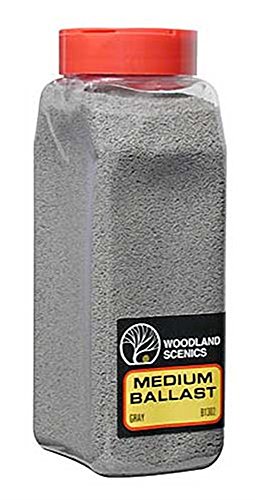
Woodland Scenics Medium Ballast Shaker Gray 50 cubic inches
$19.90Sized for HO scale mainline, the default grade most HO modelers standardize on.
Best for: HO scale main line
Check price on AmazonBallast grade is not a style choice, it is a scale decision, and the two most common grades exist for exactly two different scales. Fine ballast is sized to look right under N scale track, and medium ballast is sized to look right under HO scale track. There is no grade that looks correct under both, because the stones on a real railroad do not change size when you change scale, only the model does.
Coarse ballast exists too, for O scale and larger, and it is worth naming here because it is the grade most often used by mistake in HO, where it reads as boulders rather than crushed stone. If you are not sure which bag is already on your shelf, the ballast and scenery calculator sizes the right grade and quantity for your scale and track length before you order more.
On this page
Why does the wrong ballast grade look so obviously wrong?
The stones under a real railroad are a fixed real world size, typically one to two inches across for mainline ballast. Once you pick a scale, that real size has to shrink by the scale's proportion, so HO's 1:87.1 ratio needs visibly finer grains than a full size photo would suggest, and N scale's 1:160 ratio needs finer grains again. Medium ballast, correctly scaled for HO, is roughly twice the apparent size of fine ballast scaled for N. Put medium grade under N scale track and the individual stones look too large relative to the rail and ties, an effect the eye reads instantly as riprap or gravel rather than ballast, even before you consciously compare the two.
Is O scale ballast just a bigger version of HO ballast?
Yes, and this is where the mistake most often happens in reverse: modelers moving from HO to O gauge sometimes keep buying medium ballast out of habit, when Woodland Scenics B89 Coarse Ballast Bag Gray 18 cubic inches is the grade actually scaled correctly for O and larger. The rule of thumb is straightforward: fine for N, medium for HO, coarse for O. It is a rule of thumb rather than a hard standard, and a manufacturer's own recommendation for a specific product line should win if one is published, but it holds for the overwhelming majority of layouts.
Does ballast color matter as much as grade?
Grade decides whether the ballast looks like the right scale, and color decides whether it looks like the right railroad. A clean gray like Woodland Scenics Fine Ballast Shaker Gray 50 cubic inches or Woodland Scenics Medium Ballast Shaker Gray 50 cubic inches suits a well maintained modern mainline. A blend like Woodland Scenics Fine Ballast Shaker Gray Blend 57.7 cubic inches breaks up the flat single tone that a pure gray shaker leaves behind, which reads better under most layout lighting. Woodland Scenics Brown Ballast 32 oz Shaker suits a branch line, a yard, or an older right of way where dirt and cinders have taken over from clean stone, and Woodland Scenics Fine Ballast Shaker Buff 57.7 cubic inches suits a western or desert prototype where the local rock is not gray granite at all.
Fine, medium and coarse ballast, side by side
Fine ballast is correct for N scale, medium for HO, and coarse for O and larger, and swapping any two grades between scales is visually obvious.
| Grade | Correct scale | What happens if used in the wrong scale |
|---|---|---|
| Fine | N scale (acceptable in HO for a subtler look) | Too smooth and uniform under HO or larger track |
| Medium | HO scale | Reads as oversized gravel under N scale track |
| Coarse | O scale and larger | Reads as boulders under HO or N scale track |
These are the grades most modelers standardize on. A manufacturer-specific recommendation for a particular product line takes priority over this general rule of thumb.
How much ballast does a layout actually need?
More than the first estimate, almost every time. Ballast has to cover the shoulder on both sides of the ties as well as the space between the rails, and a shaker bottle empties faster than it looks like it should once you are working a full mainline rather than a test section. Rather than guess and reorder twice, run your actual track footage and scale through the ballast and scenery calculator, and see the full lineup of grades and colors at best model railroad ballast.
Sources
- Woodland Scenics published product specifications
Frequently asked questions
What ballast grade should I use for HO scale track?
Medium ballast is the grade sized correctly for HO scale mainline track, and it is what most HO modelers standardize on for a realistic look. Fine ballast can work in HO for a subtler, more delicate texture, but coarse ballast in HO reads as boulders rather than crushed stone.
Can I use the same ballast for N scale and HO scale?
Not the same grade. Fine ballast is scaled correctly for N and medium is scaled correctly for HO, and swapping them is visually obvious once the track is laid. If you model both scales, keep separate fine and medium shakers rather than trying to make one bag do both jobs.
What happens if I use coarse ballast on HO track?
Coarse ballast is sized for O scale and larger, and under HO track the individual stones look oversized enough that the eye reads them as riprap or boulders rather than crushed stone. It is one of the most common ballast mistakes, usually made by buying whatever bag is on the shelf without checking the label.
Does ballast color matter, or just the grade?
Both matter, for different reasons. Grade decides whether the ballast looks correctly scaled for your track. Color decides whether it matches your prototype: gray for a clean modern mainline, brown for a weathered branch line or yard, and buff or tan for a western or desert setting.
How do I fix ballast after it has already been glued down?
Ballast set with a wet adhesive like Scenic Cement can usually be broken up and lifted with water and a stiff brush while it is still fresh, but once fully cured it is easier to add a thin corrective layer of the right grade on top than to remove the wrong ballast entirely.
Is there an official standard for ballast grade by scale?
No single published standard fixes ballast grade to scale the way NMRA standards fix rail gauge. Fine for N, medium for HO and coarse for O is a widely followed rule of thumb based on how real ballast stone scales down, not an enforced specification, so a manufacturer note for a specific product can override it.
Researched, not professional advice. This page is compiled from published manufacturer specifications, instruction manuals, published NMRA standards and recommended practices, and owner-review consensus, not hands-on testing. Figures described as a rule of thumb are hobby convention rather than a standard, and they are labelled that way wherever they appear. Always check a radius, a clearance or a grade against your own equipment before you cut wood or lay rail, because manufacturers vary and so does what your specific models will tolerate. Any permanent mains wiring in a layout room is work for a licensed electrician to your local code.