Tools
Best Soldering Irons for Model Railroads
Quick answer
The best soldering iron for model railroad feeder wires is the YIHUA 926 III 60W Digital Soldering Iron Station Kit with Helping Hands at $39.99, because it is temperature-controlled and adjustable rather than fixed-wattage, delivering enough heat fast enough to make the joint before it melts the plastic ties next to it.
Soldering a feeder wire to the underside of a rail is a race against heat soaking sideways into the plastic ties. A cheap, fixed-wattage pencil iron loses that race in both directions: it is often too cool to melt solder quickly at the rail, so the tip sits in contact with the rail for several extra seconds, which is exactly long enough for the ties nearby to soften and deform. The YIHUA 926 III 60W Digital Soldering Iron Station Kit with Helping Hands solves this by letting you set a higher tip temperature and hold it there, so heat transfers into the rail fast enough that the joint forms before the surrounding plastic ever gets hot.
This page covers the iron itself. For the actual technique, see how to solder rail feeders, and for the wire itself see best model railroad wire and terminals.
On this page
- Why does soldering rail need a temperature-controlled iron specifically?
- Fixed-wattage pencil iron or temperature-controlled station: what actually changes?
- What tip and solder should I use for feeder wires?
- What else changes the outcome of a rail solder joint besides the iron?
- Beginner: one adjustable station covers a first layout completely
- Intermediate: the same station handles most home layouts at any scale
- Expert: the second tool an experienced modeler adds is a dedicated wire trimmer, not a fancier iron
Why does soldering rail need a temperature-controlled iron specifically?
Rail is a good conductor of heat, which is exactly why it is hard to solder with a weak iron: the heat you apply at one spot spreads along the rail and into the tie plate underneath faster than a low-wattage pencil iron can replace it. That forces you to hold the tip against the rail longer to get solder to flow, and the extra dwell time is what melts the tie next to the joint, not the momentary touch of a hot tip.
A temperature-controlled station set to a higher fixed temperature, typically in the 600 to 700 degree Fahrenheit range for rail work, delivers heat fast enough that the joint is made in a second or two rather than five or six. Less time in contact means less heat has a chance to soak sideways into the tie, even though the tip itself is hotter. This is the entire argument for a controlled iron over an uncontrolled one: it is not about raw wattage, it is about getting in and out fast.
Fixed-wattage pencil iron or temperature-controlled station: what actually changes?
The station itself is the only soldering-specific tool in the catalog for this job; the comparison below explains what a basic fixed iron gets wrong.
A temperature-controlled station delivers rail-melting speed at the joint without the long dwell time that damages nearby ties.
| Feature | Basic fixed iron | {{p:yihua-soldering-station|Controlled station}} |
|---|---|---|
| Temperature control | Fixed, often too cool for rail | Adjustable, digital display |
| Time in contact with rail | Longer, to compensate for low heat | Shorter, heat transfers fast |
| Risk to nearby ties | Higher, from extended dwell time | Lower, joint forms quickly |
| Included accessories | Usually none | Helping-hand holder included |
| Price | Often under $15 | $39.99 |
What tip and solder should I use for feeder wires?
A small chisel or conical tip, not the broad tip meant for larger electronics work, gives better control at the point where the wire meets the rail web. Rosin-core electronics solder, thin gauge, flows faster and needs less heat than plumbing-grade solder, which is built for a completely different joint and should not be used on rail. A small amount of liquid flux applied to the rail first helps the solder wet the joint quickly, which again shortens the time the tip needs to stay in contact.
What else changes the outcome of a rail solder joint besides the iron?
A clean rail surface matters as much as the iron's temperature. Any oxidation, oil from handling, or leftover flux residue on the rail web keeps solder from wetting the joint quickly, which forces the tip to stay in contact longer while you wait for it to flow, the exact problem a hotter iron is supposed to avoid. A light scuff with a fiberglass pen or fine abrasive right before soldering removes that film and lets the joint form in the same second or two a controlled iron is capable of.
Tip condition matters too. A tip covered in old, oxidized solder does not transfer heat efficiently even from a good station, which shows up as the same symptom as an underpowered iron: longer contact time needed to make the joint. Wiping the tip on a damp sponge or brass wool between joints and keeping a thin layer of fresh solder on it, called tinning, keeps heat transfer consistent from the first feeder to the last one on a layout with dozens of them.
Beginner: one adjustable station covers a first layout completely
There is no reason to start with anything less than temperature control; a fixed pencil iron is not actually cheaper once you count melted ties and redone joints.
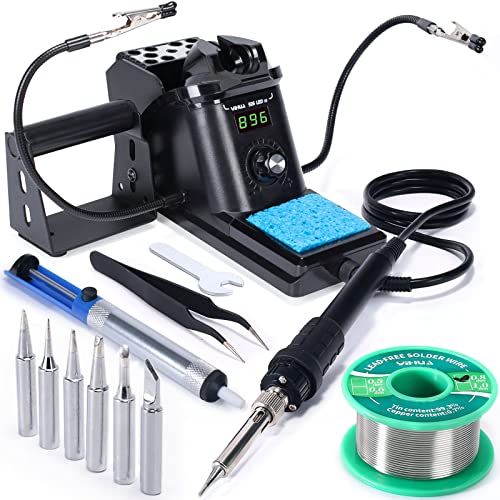
YIHUA 926 III 60W Digital Soldering Iron Station Kit with Helping Hands
$39.99Digital and adjustable from the first joint, with a helping-hand jig included so you are not holding the wire, the rail and the iron all at once.
Best for: A first flex track layout with a normal number of feeders
Check price on AmazonIntermediate: the same station handles most home layouts at any scale
A 60 watt controlled station has enough headroom for HO, N and O scale feeder work; the limiting factor for most modelers is technique, not the iron.
YIHUA 926 III 60W Digital Soldering Iron Station Kit with Helping Hands
$39.99The same unit that works for a first layout keeps working for a larger one; there is little reason to replace it on a typical home layout.
Best for: Larger layouts, multiple scales, occasional decoder wiring
Check price on AmazonExpert: the second tool an experienced modeler adds is a dedicated wire trimmer, not a fancier iron
Once feeder soldering is routine, the bottleneck shifts to prepping wire quickly and cleanly rather than to the iron itself. A dedicated cutter kept only for stripped copper wire ends, separate from the rail cutter, speeds up wiring dozens of feeders across a layout.

Xuron 410 Micro-Shear Flush Cutters
$16.04A small dedicated cutter for trimming stripped feeder ends to length, which keeps the rail-only cutter reserved for rail as covered on our tools page.
Best for: Modelers wiring feeders across a full layout, not just a handful
Check price on AmazonWho should not buy this tier: Skip a second, more expensive bench-grade soldering station. The market sells higher-end digital irons for electronics work, but the joint being made here, a short feeder wire to a rail web, does not need more than the temperature control and heat recovery a $40 hobby station already provides. Put the extra money into wire and terminals instead.
How we chose
We did not test these products in person and we never claim to. Picks are researched from manufacturer specification sheets and instruction manuals, published NMRA standards and recommended practices, and the recurring themes in verified owner reviews. Every pick is matched to a real scale, a real minimum radius or a real current draw rather than to a price bracket, and it is placed in the tier where its capability actually belongs. Where a product is wrong for most layouts we say so on the page, and where a figure is a hobby rule of thumb rather than a published standard we say that too.
Frequently asked questions
What temperature should my soldering iron be set to for rail feeders?
Most modelers set a controlled iron somewhere in the 600 to 700 degree Fahrenheit range for rail, high enough that the joint forms in a second or two. Check the specific solder and iron manufacturer instructions, since flux-core electronics solder flows at a lower temperature than plumbing solder.
Why does a cheap iron melt the ties even though it feels less powerful?
A low-wattage fixed iron cannot replace heat as fast as the rail conducts it away, so it needs longer contact time to get solder to flow. That extra dwell time, not the iron itself, is what softens the plastic tie next to the joint.
Can I solder rail feeders with the same iron I use for electronics?
Yes, as long as it is temperature-controlled and can reach a high enough setting for rail work. A basic 15 to 25 watt fixed electronics iron, the kind sold for simple circuit board work, is usually too cool to solder rail quickly.
Do I need flux to solder a feeder wire to rail?
It helps significantly. A small amount of liquid flux on the rail before soldering lets the solder wet and flow across the joint faster, which shortens the time the iron needs to stay in contact and reduces heat damage to nearby ties.
How many feeders does a typical HO layout need?
A common rule of thumb is one feeder pair every three to six feet of rail, more often on curves and turnouts where rail joiners see more stress. Our guide on wiring a DCC layout covers spacing in more detail.
Is a helping-hand jig actually necessary?
It is not required, but soldering a feeder involves holding the iron, the solder and the wire in position against the rail at the same time, which is difficult with two hands. A jig that clamps the wire frees a hand for the iron and the solder instead, and most controlled stations include one at no extra cost.
Researched, not professional advice. This page is compiled from published manufacturer specifications, instruction manuals, published NMRA standards and recommended practices, and owner-review consensus, not hands-on testing. Figures described as a rule of thumb are hobby convention rather than a standard, and they are labelled that way wherever they appear. Always check a radius, a clearance or a grade against your own equipment before you cut wood or lay rail, because manufacturers vary and so does what your specific models will tolerate. Any permanent mains wiring in a layout room is work for a licensed electrician to your local code.